


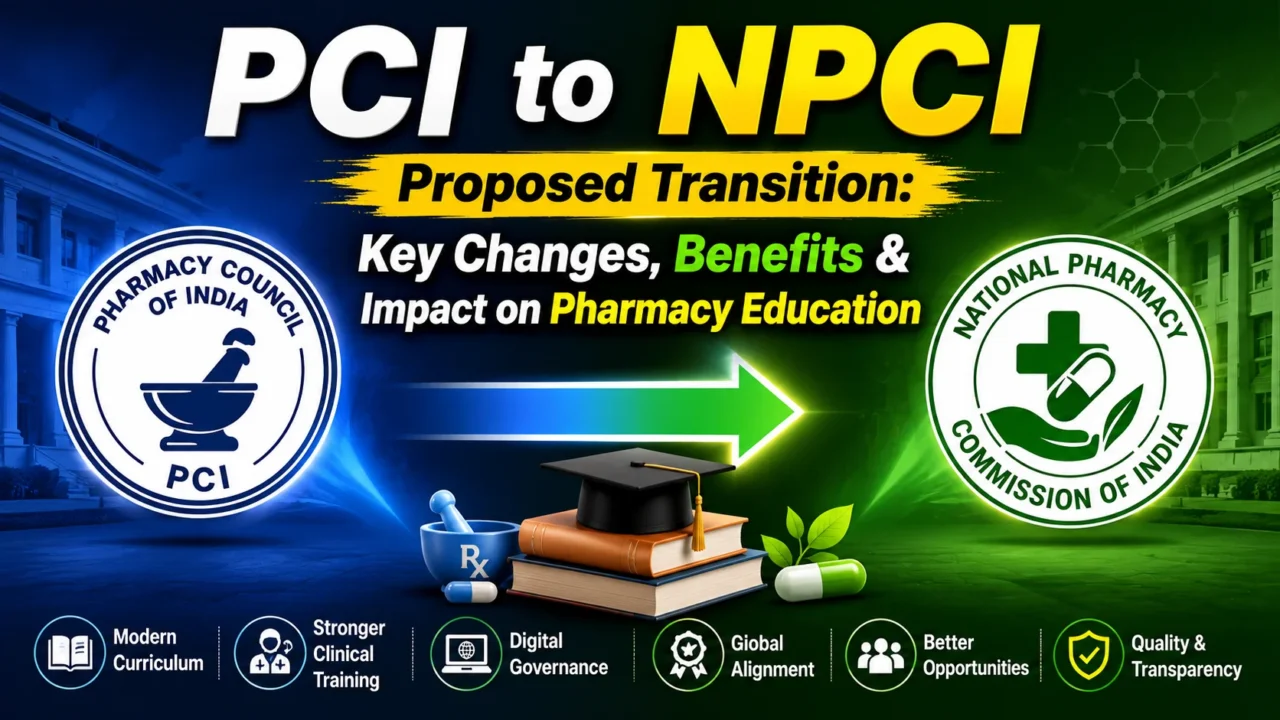

Quick Summary
The proposed transition from the Pharmacy Council of India (PCI) to the National Pharmacy Commission of India (NPCI) aims to modernize pharmacy education with competency-based learning, updated curricula, stronger clinical training, digital governance, and better alignment with global healthcare standards. The proposal is not yet implemented and will take effect only after official government approval.

Overview
India’s pharmacy education system may soon undergo one of its biggest reforms.
The Government of India has proposed replacing the Pharmacy Council of India (PCI) with the National Pharmacy Commission of India (NPCI).
The objective is to develop a modern, transparent, competency-based regulatory framework that prepares pharmacists for future healthcare challenges.
Important: This is currently only a proposal. PCI continues to function as the statutory regulator until an official notification is issued.

What is PCI?
The Pharmacy Council of India (PCI) is the statutory body established under the Pharmacy Act, 1948.
Major Responsibilities
- Approval of pharmacy colleges
- Regulation of pharmacy education
- Prescribing educational standards
- Registration of pharmacists
- Maintaining quality in pharmacy education
For decades, PCI has been responsible for regulating pharmacy education across India.
Why is NPCI Being Proposed?
Healthcare is rapidly evolving with advancements in:
- Artificial Intelligence
- Clinical Pharmacy
- Personalized Medicine
- Digital Healthcare
- Pharmaceutical Research
- Patient Safety
- Telemedicine
To meet these changing healthcare needs, the Government has proposed the National Pharmacy Commission of India (NPCI).
The new framework is expected to emphasize practical skills, competency, transparency, and innovation.
PCI vs NPCI: Proposed Comparison
| Feature | Current PCI | Proposed NPCI |
|---|---|---|
| Education Model | Syllabus-based | Competency-based |
| Curriculum | Traditional | Modern & Updated |
| Learning | Theory-focused | Outcome-focused |
| Clinical Training | Limited | Stronger Clinical Exposure |
| Governance | Manual | Digital Governance |
| Accreditation | Existing Model | Transparent & Quality-Based |
| Healthcare Integration | Limited | Better Integration |
| Global Standards | Partial | Internationally Aligned |
Proposed Key Changes
1. Competency-Based Education
The proposed system focuses on developing practical competencies instead of only completing the syllabus.
Students may be evaluated based on:
- Clinical skills
- Communication
- Patient counselling
- Professional ethics
- Problem-solving abilities
2. Outcome-Focused Learning
Learning outcomes may become the primary focus instead of examination scores.
Graduates should demonstrate practical competencies required in hospitals, community pharmacies, and the pharmaceutical industry.
3. Curriculum Modernization
The curriculum may include modern healthcare subjects such as:
- Artificial Intelligence in Pharmacy
- Digital Health
- Telepharmacy
- Pharmacovigilance
- Precision Medicine
- Healthcare Informatics
- Pharmaceutical Data Science
4. Globally Aligned Curriculum
The proposal aims to harmonize pharmacy education with international standards.
Potential benefits include:
- Better international recognition
- Improved research collaboration
- Enhanced academic mobility
- Global employment opportunities
5. Greater Focus on Clinical Pharmacy
Clinical pharmacy training may receive increased emphasis through:
- Hospital postings
- Clinical case discussions
- Medication therapy management
- Patient counselling
- Drug information services
6. Improved Regulation & Accreditation
NPCI is expected to strengthen:
- Institutional quality assurance
- Accreditation standards
- Transparency
- Regular monitoring
- Accountability
7. Digital Governance
The proposed framework may introduce:
- Online approvals
- Digital inspections
- Paperless processes
- Time-bound approvals
- Technology-driven monitoring
8. Better Integration with Healthcare
The proposal emphasizes stronger collaboration between pharmacy professionals and the healthcare system through:
- Public health programs
- Primary healthcare
- Medication management
- Preventive healthcare
- Patient safety initiatives
Expected Benefits
If implemented, the proposed reforms may provide:
- Modern pharmacy curriculum
- Practical learning
- Better clinical exposure
- Digital governance
- Faster institutional approvals
- Increased transparency
- Global competitiveness
- Improved patient care
- Better career opportunities
Impact on Pharmacy Students
Students may benefit from:
- Updated curriculum
- Skill-based education
- Better internships
- Clinical competency
- Improved employability
- Industry-ready training
Impact on Pharmacy Colleges
Institutions may need to:
- Upgrade laboratories
- Improve faculty development
- Strengthen hospital collaborations
- Enhance digital infrastructure
- Meet revised accreditation standards
Current Status
| Particular | Status |
|---|---|
| Proposal Released | Yes |
| Government Approval | Pending |
| Official Notification | Not issued |
| PCI Replaced | No |
| Current Regulator | Pharmacy Council of India (PCI) |
Important Information
| Particular | Details |
|---|---|
| Official Notification | Not issued |
| Effective Date | Not mentioned in the official notification |
| Existing Pharmacy Degrees | No change announced |
| Registration Process | No official changes announced |
Why Should Pharmacy Students Know About This?
Understanding the proposed reforms can help students prepare for future changes in pharmacy education.
Possible advantages include:
- Better career opportunities
- International recognition
- Practical learning
- Stronger clinical skills
- Industry readiness
- Improved professional competency
Frequently Asked Questions (FAQs)
1. Is PCI replaced by NPCI?
No. The transition is currently proposed and has not been officially implemented.
2. Will existing pharmacy degrees remain valid?
Yes. No official notification has stated that existing degrees will lose validity.
3. Why is NPCI being proposed?
The proposal aims to modernize pharmacy education through competency-based learning, stronger clinical training, digital governance, and improved transparency.
4. Will the pharmacy syllabus change?
If the proposal is approved, the curriculum may be updated to include modern healthcare topics and practical competencies.
5. Will pharmacist registration change?
No official changes have been announced regarding pharmacist registration.
6. When will NPCI be implemented?
Not mentioned in the official notification. The proposal will take effect only after government approval and notification.
7. Should pharmacy students worry?
No. Students should continue following the current PCI regulations until official updates are released.
8. What is the biggest expected benefit of NPCI?
The proposed system aims to create practice-ready pharmacists through competency-based education, stronger clinical exposure, and modern governance.
Conclusion
The proposed PCI to NPCI transition represents a significant vision for the future of pharmacy education in India. By focusing on competency-based education, modern curricula, stronger clinical practice, digital governance, and transparency, the reform seeks to prepare pharmacists for the evolving healthcare landscape.
However, it is important to remember that NPCI has not yet replaced PCI. Until an official notification is issued by the Government of India, PCI remains the statutory authority governing pharmacy education.
Students, educators, and pharmacy institutions should stay informed through official announcements while continuing to follow existing PCI guidelines.
Recommended Products