



Introduction
After successfully clearing the Computer Based Test (CBT) and Document Verification (DV), candidates must undergo the RRB Medical Examination before receiving a final appointment in Indian Railways. Many candidates are curious about what happens during the railway medical test, what tests are conducted, and the reasons why some candidates get rejected.
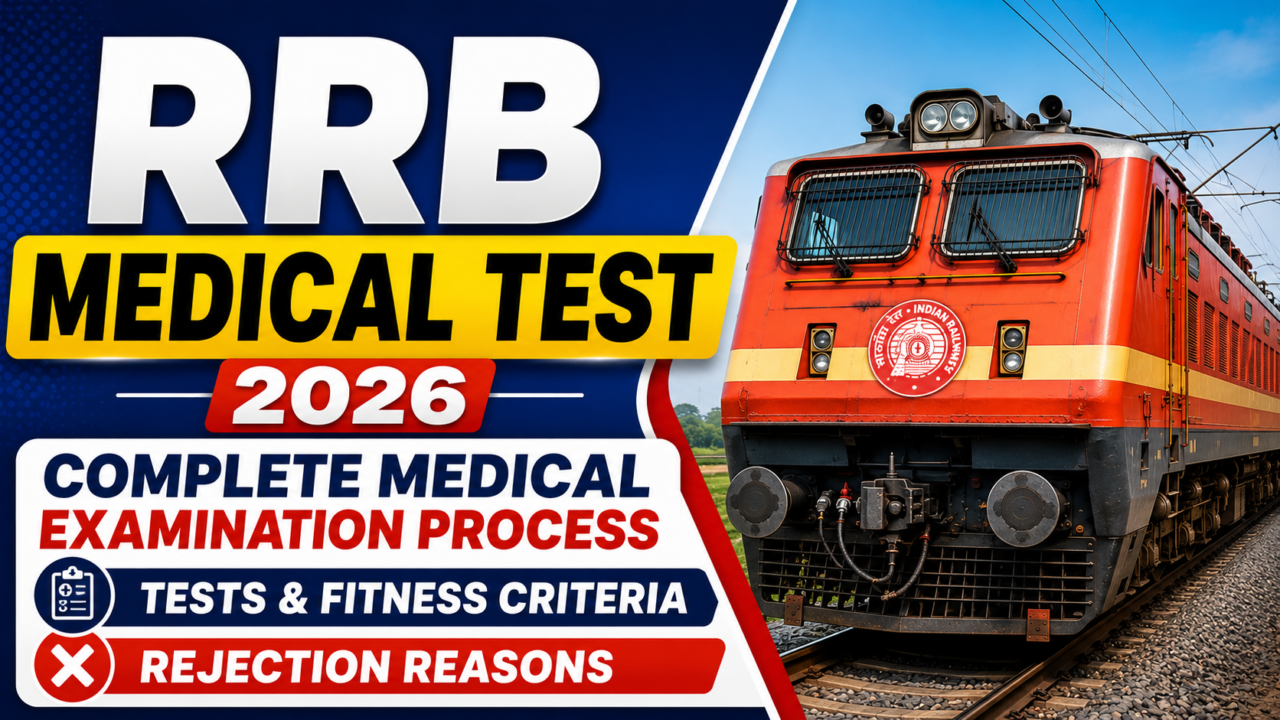
In this detailed guide, we explain the complete RRB Medical Test 2026 process, medical standards, fitness criteria, eye examination requirements, and common rejection reasons.
What is the RRB Medical Test?
The Railway Medical Test is a mandatory health examination conducted by Railway Hospitals or authorized Railway Health Units. Its purpose is to ensure that candidates are medically fit to perform the duties associated with their respective railway posts.
A candidate who fails to meet the prescribed medical standards may be declared medically unfit, even after clearing the written examination and document verification.
When is the Medical Test Conducted?
The medical examination is usually conducted:
- After Document Verification (DV)
- On the same day or the next day after DV
- At a designated Railway Hospital or Health Unit
Candidates are advised to keep 3–4 days available for completing the entire process.
Complete RRB Medical Test Process
Step 1: Registration at Railway Hospital
Upon arrival at the Railway Hospital:
- Candidate identity is verified.
- Documents are checked.
- Medical examination form is issued.
- Basic information is recorded.
Step 2: Height and Weight Measurement
Doctors measure:
- Height
- Weight
- Body Mass Index (BMI)
Extreme obesity or severe underweight conditions may require further medical evaluation.
Step 3: Blood Pressure Check
Candidates undergo:
- Blood Pressure (BP) Test
- Pulse Rate Examination
Abnormally high blood pressure may lead to additional investigations.
Step 4: Eye Examination
The eye test is one of the most important parts of the railway medical examination.
Doctors check:
- Distance Vision
- Near Vision
- Color Vision
- Night Vision (for specific categories)
- Binocular Vision
- Visual Acuity
For safety-related posts, eye standards are very strict.

Step 5: Color Blindness Test
Candidates are tested using:
- Ishihara Color Charts
- Color Recognition Tests
Color blindness is one of the major reasons for rejection in technical and safety categories.
Step 6: Hearing Test
Medical officers evaluate:
- Hearing ability
- Ear health
- Ability to hear normal conversations
Severe hearing impairment may result in disqualification.
Step 7: General Physical Examination
Doctors examine:
- Chest condition
- Respiratory system
- Heart function
- Abdomen
- Limbs and joints
- Spine alignment
- Neurological condition
The objective is to identify any physical condition that may affect job performance.
Step 8: Laboratory Tests
Depending on the category and medical requirements, candidates may undergo:
- Blood Test
- Urine Test
- Sugar Test
- Additional pathology tests
These tests help identify serious health conditions.
Step 9: X-Ray Examination
In some cases, candidates may be advised:
- Chest X-Ray
- Other diagnostic imaging
This is generally done to rule out serious medical conditions.
Step 10: Final Medical Assessment
After reviewing all reports:
- Candidate is declared Fit
- Candidate is declared Temporarily Unfit
- Candidate is declared Permanently Unfit
The final decision is made by the Railway Medical Board.
RRB Medical Fitness Categories
Indian Railways uses different medical standards depending on the post.
A-1 Medical Standard
Highest medical standard.
Applicable for:
- Loco Pilot
- Assistant Loco Pilot
- Train Operations
Requirements:
- Excellent vision
- Perfect color perception
- High physical fitness
A-2 Medical Standard
Required for certain operational and technical posts.
Requires:
- Good eyesight
- Good hearing ability
- No significant physical disability
A-3 Medical Standard
Slightly relaxed compared to A-1 and A-2.
Applicable for many technical posts.
B-1 Medical Standard
Commonly applicable to:
- Technical staff
- Supervisory positions
Requires satisfactory vision and overall fitness.
B-2 Medical Standard
Moderate medical requirements.
Suitable for various non-safety categories.
C-1 Medical Standard
Applicable for:
- Clerical
- Office-related positions
Vision requirements are less strict.
C-2 Medical Standard
Least stringent category.
Applicable for certain administrative and support roles.
Common Reasons for Rejection in RRB Medical Test
Many candidates get rejected due to medical reasons despite clearing the examination.
1. Poor Eyesight
- Vision below prescribed standard
- Uncorrectable vision defects
2. Color Blindness
Especially critical for:
- ALP
- Technician
- Safety category posts
3. Hearing Problems
Severe hearing loss can result in rejection.
4. High Blood Pressure
Uncontrolled hypertension may lead to medical unfitness.
5. Serious Heart Disease
Any significant cardiovascular disorder may affect eligibility.
6. Diabetes Complications
Advanced diabetic conditions may impact fitness status.
7. Physical Disabilities Not Matching Post Requirements
Physical limitations that interfere with job duties may result in rejection.
8. Neurological Disorders
Conditions affecting coordination, balance, or consciousness can lead to disqualification.
9. Chronic Respiratory Diseases
Severe asthma or lung-related conditions may require further assessment.
10. Fake Medical Information
Concealing medical history or submitting false information can result in cancellation of candidature.
Can Candidates Appeal Against Medical Rejection?
Yes.
If declared medically unfit, candidates may:
- Apply for a medical re-examination (where permitted)
- Request review by an Appellate Medical Board
- Follow instructions provided by the concerned RRB
The final decision of the medical board is generally binding.
Tips to Clear the RRB Medical Test
Maintain Eye Health
- Get an eye examination before DV.
- Check vision standards for your post.
Control Blood Pressure
- Avoid stress before the examination.
- Follow a healthy lifestyle.
Stay Fit
- Maintain healthy body weight.
- Exercise regularly.
Carry All Documents
Keep:
- DV documents
- Identity proof
- Medical-related records (if applicable)
Be Honest
Always disclose previous surgeries or medical conditions honestly.
Frequently Asked Questions (FAQs)
Is the RRB Medical Test Difficult?
No. The medical examination checks whether a candidate meets the health standards required for the post.
Is Spectacle Allowed in Railway Medical Test?
Yes, for many categories. However, safety categories have specific vision standards.
Does Railway Conduct Blood Tests?
Yes. Blood and urine tests may be conducted depending on the post and medical requirements.
Can I Join Railways if I Am Color Blind?
Generally, candidates applying for safety-related categories may be rejected if they fail the color vision test.
How Long Does the Medical Examination Take?
Usually 1–2 days, but the entire DV and medical process may take up to 3–4 days.
Conclusion
The RRB Medical Test 2026 is the final and most crucial stage before appointment in Indian Railways. Candidates should understand the medical standards applicable to their post and prepare accordingly. Maintaining good health, checking eyesight beforehand, and carrying all required documents can significantly improve the chances of successful medical clearance.
Remember, clearing the CBT and DV is not enough. Final selection depends on meeting the prescribed railway medical fitness standards. Therefore, candidates should take the medical examination seriously and be fully prepared for every stage of the process.
Recommended Products