


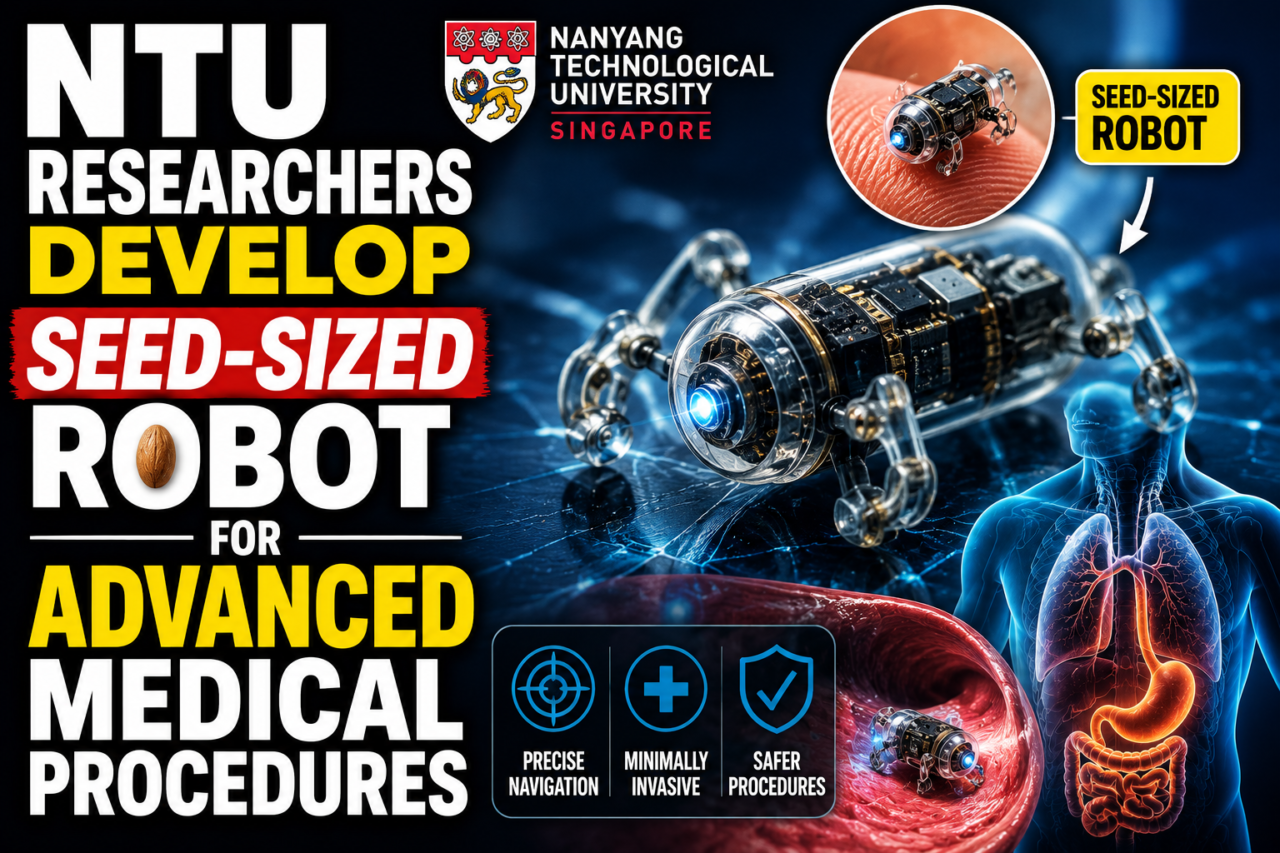

Scientists at Nanyang Technological University (NTU), Singapore have developed an advanced miniature surgical robot capable of performing multiple medical functions wirelessly inside the human body. The ultra-small robot, measuring only 4.4 millimetres in length — roughly the size of a seed — represents a major breakthrough in minimally invasive medical technology.
Researchers believe this innovation could transform future surgical procedures by enabling highly precise treatments with reduced damage to surrounding tissues.
A Tiny Robot with Multiple Medical Functions
Unlike most miniature medical robots that can perform only one or two tasks, the newly developed device combines five important surgical capabilities into a single tiny platform.
The robot can:
- Move across soft tissues
- Cut biological material
- Deliver drugs directly to targeted areas
- Grip and collect tissue samples
- Generate heat remotely
According to the research team, the robot can switch between these functions in less than a second using weak magnetic fields.
Developed by NTU Singapore Researchers
The project was led by Associate Professor Lum Guo Zhan from NTU’s School of Mechanical and Aerospace Engineering.
The researchers designed the robot using soft silicone-based materials embedded with microscopic magnetic particles. Different sections of the robot respond differently to external magnetic fields, allowing individual tools and movements to activate independently.
This is a significant advancement because one of the biggest challenges in miniature robotics is that small magnetic robots usually behave like a single magnet, limiting their functionality and precision.
How the Technology Works
The innovative design allows researchers to remotely control specific parts of the robot without affecting the entire device.
By carefully arranging microscopic magnetic particles inside different sections of the soft body, scientists created a system where:
- One section can grip tissue
- Another can cut material
- Another can deliver medicine
All functions can be controlled wirelessly from outside the body using magnetic fields.
This flexible multi-functional design improves surgical precision while reducing the need for multiple devices during medical procedures.
Potential Medical Applications
The tiny “5-in-1” robot could have several important medical applications in the future, including:
- Minimally invasive surgery
- Targeted drug delivery
- Tissue biopsy collection
- Internal diagnostics
- Precision treatment in hard-to-reach areas
Because of its extremely small size, the robot may eventually help doctors perform procedures inside delicate organs and narrow blood vessels with minimal trauma.
Advantages of Minimally Invasive Robotics
Minimally invasive procedures are becoming increasingly important in modern healthcare because they can:
- Reduce surgical pain
- Lower infection risk
- Shorten recovery time
- Minimize tissue damage
- Improve surgical precision
The NTU robot could further enhance these benefits by allowing multiple procedures to be performed using a single miniature device.

Future Challenges and Development
Although the technology is highly promising, researchers note that further testing and development are still needed before clinical use in humans.
Future research will focus on:
- Improving navigation inside the body
- Enhancing control precision
- Testing long-term safety
- Developing real-time imaging integration
- Preparing for clinical trials
Scientists believe the platform could eventually become part of next-generation robotic medicine.
A Major Step Forward in Medical Robotics
The development highlights the rapid progress being made in soft robotics, nanotechnology, and biomedical engineering. Combining multiple surgical functions into such a tiny wireless device is considered a major engineering achievement.
As medical robotics continues to evolve, technologies like this could redefine how surgeries and internal treatments are performed in the future.
Final Thoughts
NTU Singapore’s seed-sized “5-in-1” surgical robot marks an exciting breakthrough in minimally invasive healthcare technology. By combining movement, cutting, drug delivery, tissue sampling, and heating functions into one ultra-small platform, the innovation could pave the way for safer, smarter, and more precise medical procedures.
While more research is needed before human use, the study demonstrates the enormous potential of miniature robotic systems in shaping the future of medicine.
Recommended Products