

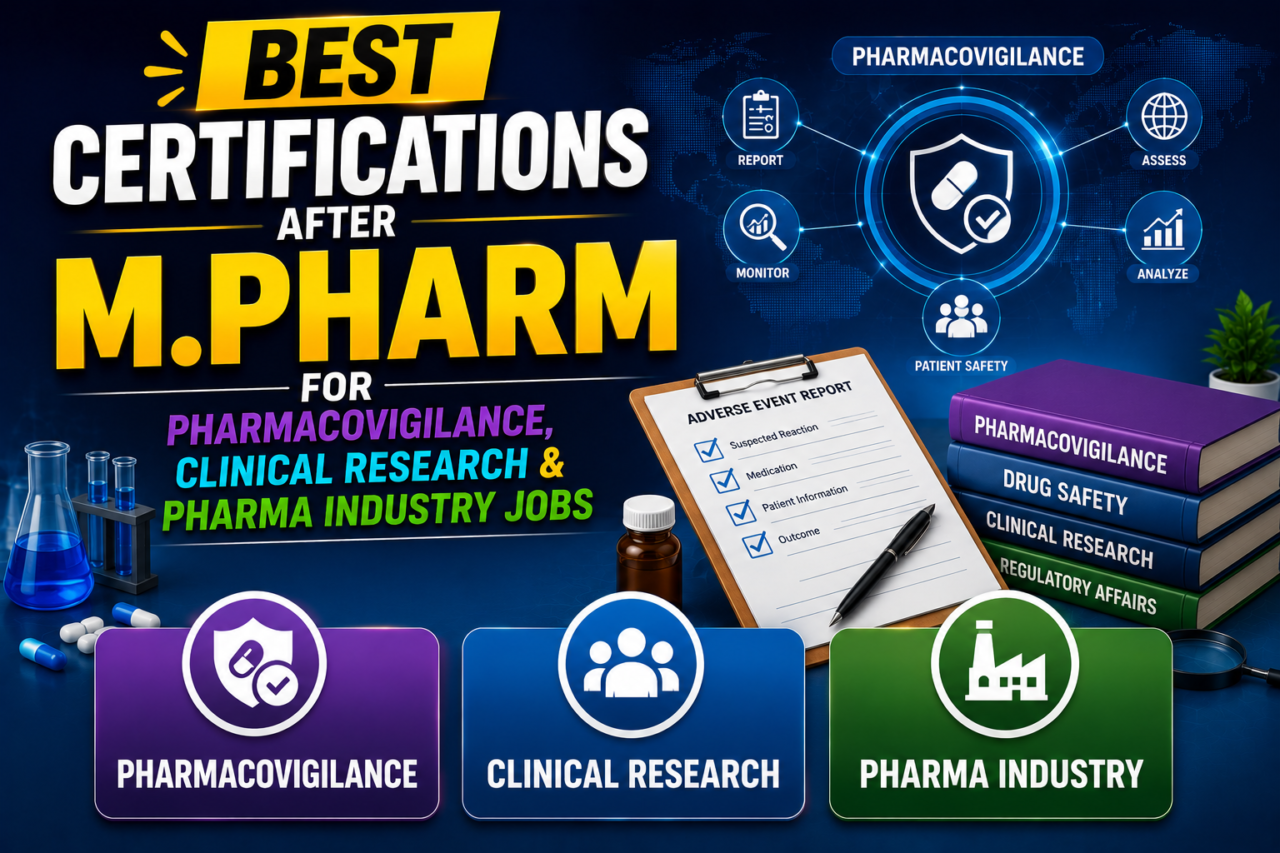

The pharmaceutical industry is evolving rapidly, and companies today are looking for candidates who not only have academic qualifications like M.Pharm but also possess practical industry-oriented skills. This is why certifications have become extremely important for pharmacy students and professionals.
Whether you want a career in pharmacovigilance, clinical research, regulatory affairs, medical coding, or the pharmaceutical industry, the right certification can improve your:
- Job opportunities
- Salary package
- Industry skills
- Professional credibility
Many M.Pharm students struggle to decide which certification is best for their career goals. This guide explains the best certifications after M.Pharm that can help students build successful careers in high-demand pharmaceutical sectors.
Why Certifications Are Important After M.Pharm
An M.Pharm degree provides strong academic knowledge, but certifications help students gain:
- Practical industry exposure
- Technical skills
- Updated healthcare knowledge
- Better interview performance
- Specialized expertise
Certified professionals are often preferred by:
- Pharmaceutical companies
- Clinical research organizations (CROs)
- Healthcare companies
- Multinational corporations (MNCs)
because they are considered more industry-ready.

1. Pharmacovigilance Certification
Pharmacovigilance is one of the most popular non-clinical careers for M.Pharm students.
What You Learn
- Adverse Drug Reaction (ADR) reporting
- Drug safety monitoring
- Case processing
- Signal detection
- Medical coding
- Global safety databases
Career Opportunities
- Drug Safety Associate
- Pharmacovigilance Executive
- Medical Reviewer
- Safety Scientist
Why It’s in Demand
Global pharmaceutical companies are continuously expanding drug safety operations due to strict healthcare regulations.
Average Salary
- Freshers: ₹3–5 LPA
- Experienced: ₹8–15 LPA
2. Clinical Research Certification
Clinical research certifications are ideal for students interested in drug development and clinical trials.
Topics Covered
- Clinical trial phases
- Good Clinical Practice (GCP)
- Ethics in clinical research
- Data management
- Regulatory guidelines
Career Roles
- Clinical Research Associate (CRA)
- Clinical Trial Coordinator
- Clinical Data Associate
Benefits
- International career opportunities
- Strong industry demand
- Excellent salary growth
3. Regulatory Affairs Certification
Regulatory Affairs professionals handle drug approval and compliance processes.
Skills Learned
- Drug registration
- CTD/eCTD submissions
- Regulatory documentation
- FDA & CDSCO guidelines
Career Scope
Every pharmaceutical company requires regulatory professionals for product approvals and documentation.
Job Roles
- Regulatory Affairs Associate
- Regulatory Executive
- Dossier Specialist
4. Medical Writing Certification
Medical writing is becoming one of the highest-paying non-clinical careers for pharmacy graduates.
What You Learn
- Scientific writing
- Clinical documentation
- Research article writing
- Regulatory writing
- Healthcare content development
Advantages
- Work-from-home opportunities
- Freelancing options
- International projects
Career Roles
- Medical Writer
- Scientific Writer
- Regulatory Writer
5. Clinical Data Management (CDM) Certification
Clinical data management professionals manage and analyze clinical trial data.
Skills Covered
- Clinical databases
- Data validation
- Query management
- Electronic Data Capture (EDC)
Industry Demand
The rise of digital healthcare and clinical trials has increased demand for CDM professionals globally.
6. SAS Programming Certification
SAS programming is highly valuable in clinical research and biostatistics.
What You Learn
- Statistical programming
- Clinical data analysis
- Report generation
- Data interpretation
Career Opportunities
- SAS Programmer
- Clinical Data Analyst
- Biostatistics Associate
Salary Potential
SAS-certified professionals often receive higher salaries compared to many entry-level pharma roles.
7. Medical Coding Certification
Medical coding is a rapidly growing healthcare IT career for pharmacy graduates.
Skills Included
- ICD coding
- CPT coding
- Healthcare documentation
- Insurance coding systems
Benefits
- Easy entry for freshers
- Stable office-based career
- Remote work opportunities
8. Quality Assurance (QA) & GMP Certification
QA certifications are highly useful for students entering pharmaceutical manufacturing industries.
Topics Covered
- Good Manufacturing Practices (GMP)
- Quality systems
- Validation
- Documentation
Career Roles
- QA Executive
- Validation Associate
- Compliance Officer
9. Intellectual Property Rights (IPR) & Patent Certification
Students interested in pharmaceutical innovation and patent law can benefit from IPR certifications.
Career Opportunities
- Patent Analyst
- Patent Associate
- Intellectual Property Consultant
This field is growing rapidly in pharmaceutical research and drug development.
10. Artificial Intelligence & Data Analytics Certifications
AI and healthcare technology are becoming future-focused areas in pharmacy.
Trending Skills
- AI in healthcare
- Machine learning basics
- Healthcare analytics
- Digital health systems
Students with technical and pharmaceutical knowledge may have excellent future opportunities in this area.
Best Online Platforms for Pharma Certifications
Students can explore certifications from:
Many institutes in India also provide industry-oriented certification programs.
Which Certification is Best After M.Pharm?
| Career Goal | Recommended Certification |
|---|---|
| Drug Safety | Pharmacovigilance |
| Clinical Trials | Clinical Research |
| Pharma Manufacturing | QA/GMP |
| Non-Clinical Career | Medical Coding |
| Research & Statistics | SAS Programming |
| Documentation & Writing | Medical Writing |
| Pharma Regulations | Regulatory Affairs |
How to Choose the Right Certification
Before selecting any certification, students should consider:
- Personal interest
- Career goals
- Industry demand
- Salary potential
- Future growth
- Course quality
- Practical training opportunities
Choosing a certification only because it is “trending” may not always lead to long-term career satisfaction.
Skills That Increase Job Opportunities
Along with certifications, M.Pharm students should improve:
- Communication skills
- English writing
- Computer knowledge
- Presentation skills
- Scientific understanding
- Research abilities
Practical skills combined with certifications provide the best career advantage.
Future Scope of Pharma Certifications
The future pharmaceutical industry will increasingly depend on:
- Drug safety monitoring
- Digital healthcare
- Clinical research
- Artificial intelligence
- Regulatory compliance
- Personalized medicine
Professionals with specialized certifications will continue to have better job opportunities and salary growth.
Recommended Products