

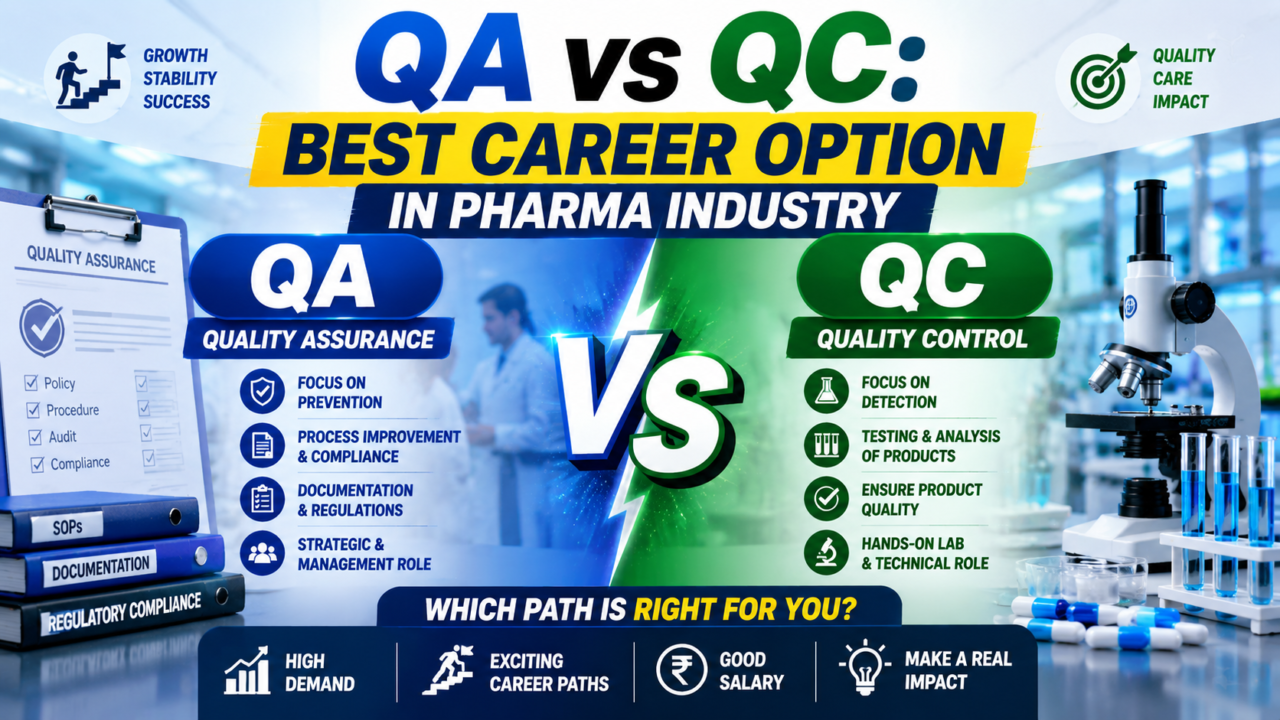

The pharmaceutical industry offers many career opportunities for pharmacy students, but two of the most popular and important departments are Quality Assurance (QA) and Quality Control (QC).
Many freshers often get confused about:
- What is the difference between QA and QC?
- Which department has better career growth?
- Which role offers higher salary opportunities?
- Which is better for pharmacy students?
Both QA and QC play critical roles in ensuring the safety, quality, and effectiveness of pharmaceutical products. However, the nature of work, required skills, and career paths are different.
In this blog, we will compare QA vs QC in detail and help you choose the best career option in the pharma industry.
What is Quality Assurance (QA)?
Quality Assurance focuses on maintaining and improving the overall quality system in pharmaceutical manufacturing.
QA ensures that medicines are produced according to:
- GMP guidelines,
- SOPs,
- regulatory standards,
- and company quality policies.
The QA department works to prevent quality issues before they happen.
Main Responsibilities of QA
QA professionals handle:
- SOP preparation and review
- Batch record review
- GMP compliance
- Documentation management
- Validation processes
- Change control
- Deviation handling
- Internal audits
- Regulatory compliance
QA mainly focuses on:
“Preventing defects and maintaining quality systems.”
What is Quality Control (QC)?
Quality Control focuses on testing and analyzing pharmaceutical products.
QC professionals check whether raw materials, packaging materials, intermediate products, and finished medicines meet required quality standards.
QC mainly works in laboratories using analytical instruments and testing procedures.
Main Responsibilities of QC
QC professionals handle:
- Sample testing
- Raw material analysis
- Finished product testing
- HPLC operation
- Dissolution testing
- Stability testing
- Laboratory documentation
- Instrument calibration
QC mainly focuses on:
“Detecting defects through testing and analysis.”


Major Difference Between QA and QC
| Feature | QA | QC |
|---|---|---|
| Full Form | Quality Assurance | Quality Control |
| Main Focus | Prevent defects | Detect defects |
| Work Area | Documentation & compliance | Laboratory testing |
| Nature of Work | System-oriented | Product-oriented |
| Instruments Used | Less technical instruments | HPLC, GC, UV, Dissolution |
| Work Environment | Office + manufacturing area | Laboratory |
| Key Goal | Maintain quality systems | Test product quality |
Skills Required for QA
To build a successful career in QA, students should develop:
Important QA Skills
- GMP knowledge
- Documentation skills
- SOP handling
- Attention to detail
- Communication skills
- Regulatory understanding
- Problem-solving ability
QA professionals must be disciplined and detail-oriented.
Skills Required for QC
QC requires more technical and laboratory-based skills.
Important QC Skills
- HPLC basics
- Analytical chemistry
- Instrument handling
- Laboratory techniques
- Data analysis
- Observation skills
Students who enjoy laboratory work often prefer QC.
Which Department is Better for Freshers?
Both departments offer good opportunities for freshers.
QA for Freshers
Freshers usually start as:
- QA trainee
- Documentation assistant
- IPQA trainee
QA can initially feel difficult because it involves extensive documentation and GMP understanding.
QC for Freshers
QC is often preferred by students who:
- enjoy practical laboratory work,
- like instruments,
- and have strong analytical interest.
Freshers may join as:
- QC analyst trainee
- Microbiology trainee
- Laboratory assistant
Salary Comparison: QA vs QC
Salary depends on company size, location, and skills.
Average Fresher Salary in India
QA
₹2.5 – ₹4.5 LPA
QC
₹2 – ₹4 LPA
Experienced professionals in both departments can earn significantly higher salaries.
Career Growth in QA
QA offers excellent long-term growth opportunities.
Career Path in QA
QA Trainee → QA Officer → Senior Executive → Assistant Manager → QA Manager → Quality Head
QA professionals are highly important during:
- audits,
- regulatory inspections,
- and compliance management.
Many senior leadership roles in pharma come from QA backgrounds.
Career Growth in QC
QC also offers strong technical growth opportunities.
Career Path in QC
QC Trainee → QC Analyst → Senior Analyst → QC Executive → QC Manager → Laboratory Head
Experienced QC professionals can specialize in:
- analytical development,
- stability studies,
- method validation,
- and microbiology.
Which is More Stressful?
Both departments have pressure, but in different ways.
QA Stress Areas
- Audit pressure
- Documentation errors
- Regulatory inspections
- Compliance deadlines
QC Stress Areas
- Testing deadlines
- Instrument issues
- OOS investigations
- Laboratory workload
Which Department Has Better Future Scope?
Both QA and QC have strong futures because pharmaceutical companies must maintain strict quality standards.
However:
QA is growing rapidly because:
- regulatory requirements are increasing,
- documentation systems are expanding,
- and compliance standards are becoming stricter.
QC remains essential because:
- every batch of medicine must be tested,
- laboratory analysis is mandatory,
- and analytical technology is continuously advancing.
QA vs QC: Which Should You Choose?
Choose QA if you:
- like documentation work,
- prefer management-oriented roles,
- enjoy compliance systems,
- and want leadership growth.
Choose QC if you:
- enjoy laboratory work,
- like instruments and testing,
- prefer technical analysis,
- and are interested in analytical chemistry.
Best Courses for QA & QC Careers
Students can improve job opportunities through additional certifications.
Recommended Courses
- GMP Certification
- HPLC Training
- Validation Training
- Regulatory Affairs Course
- Documentation Training
- Analytical Instrumentation
Online learning platforms like Coursera and Udemy offer useful pharma-related programs.
Top Pharma Companies Hiring QA & QC Professionals
Many leading pharma companies recruit QA and QC professionals regularly.
Popular Pharma Companies
- Sun Pharmaceutical Industries
- Cipla
- Dr. Reddy’s Laboratories
- Lupin
- Aurobindo Pharma
- Torrent Pharmaceuticals
Final Thoughts
Both QA and QC are excellent career options in the pharmaceutical industry. There is no single “best” department for everyone because the right choice depends on your interests, strengths, and career goals.
If you enjoy:
- compliance,
- documentation,
- and management systems,
then QA may be the better option.
If you prefer:
- laboratory analysis,
- instruments,
- and technical testing,
then QC may suit you better.
The pharmaceutical industry needs skilled professionals in both departments, and both offer stable careers, good salaries, and long-term growth opportunities.
Recommended Products