

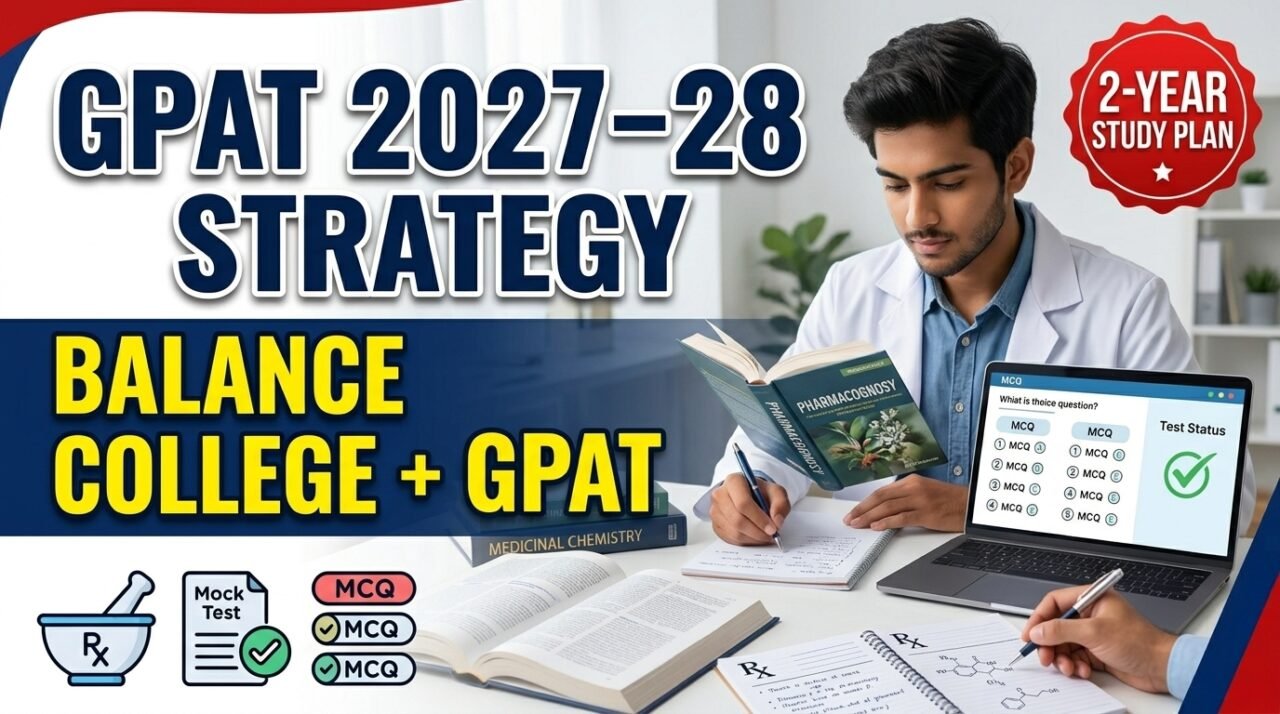

Many pharmacy students often ask one common question:
“Can I manage semester exams and GPAT preparation together?”
The answer is YES. In fact, both complement each other when planned properly. Semester theory builds conceptual understanding, while GPAT focuses on application-based learning and MCQ practice.
Why GPAT Preparation Along With College is Possible
Most subjects studied during B.Pharm semesters are directly connected with GPAT syllabus. If students study smartly, semester preparation itself becomes a strong base for GPAT.
Key Benefits
- Theory subjects strengthen concepts
- GPAT preparation improves analytical thinking
- MCQ practice increases retention
- Revision becomes easier before university exams
Smart Strategy to Balance Semester & GPAT Preparation
Students should avoid treating GPAT as an extra burden. Instead, integrate it into daily study routine.
Effective Study Plan
| Activity | Strategy |
|---|---|
| Theory Study | Study concepts deeply |
| GPAT Practice | Solve MCQs from same topic |
| Notes Making | Prepare short concept-based notes |
| Weekend Routine | Revise weak topics + mock tests |
| Daily Revision | 1–2 hours dedicated GPAT revision |
Concept + Practice = Success

Importance of Consistency in GPAT Preparation
Many students fail not because of lack of intelligence, but because of inconsistency.
Golden Rules for Consistency
- Study daily at fixed timing
- Focus on small daily progress
- Avoid studying randomly for long hours
- Track daily targets
- Never break the study routine
Consistency > Intensity
Even 3–4 productive hours daily can create excellent GPAT results over time.
GPAT Smart Preparation Strategy
A proper GPAT strategy should focus on both high-yield and low-yield subjects.
High Yield Subjects
These subjects carry maximum weightage and require:
- Daily revision
- MCQ practice
- PYQ analysis
- Strong conceptual clarity
Major High Yield Areas
| Subject | Importance |
|---|---|
| Pharmaceutics | Very High |
| Pharmacology | Very High |
| Pharmaceutical Chemistry | Very High |
Low Yield Subjects
These subjects should not be ignored completely.
Preparation Method
- Study 1–2 hours daily
- Focus on important topics
- Revise PYQs
- Prepare quick notes
Smart strategy means strengthening high-yield subjects while maintaining low-yield coverage.
Importance of Mock Tests in GPAT Preparation
Mock tests play a major role in improving performance.
Benefits of Mock Tests
| Benefit | Impact |
|---|---|
| Improves speed | Faster question solving |
| Increases accuracy | Fewer negative marks |
| Builds confidence | Better exam temperament |
| Improves concentration | Helps in long exam duration |
Smart Online Test Strategy
Students preparing for GPAT should develop online exam habits.
Tips for Online Test Practice
- Give tests at fixed timing
- Avoid distractions
- Practice rough calculations
- Analyze mistakes after every mock
- Revise incorrect questions regularly
Mock tests are for improvement, not for judging yourself.
GPAT Subject-Wise Weightage
Understanding subject-wise question distribution helps students prioritize preparation.
| Subject | 2024 | 2025 | 2026 |
|---|---|---|---|
| Pharmaceutics & Allied | 38 | 38 | 38 |
| Pharmacology & Allied | 28 | 35 | 35 |
| Pharmacognosy | 10 | 9 | 9 |
| Pharmaceutical Chemistry & Allied | 38 | 30 | 31 |
| Other Subjects | 11 | 13 | 12 |
| Total Questions | 125 | 125 | 125 |
GPAT 2026 Expected Cutoff
| Category | Cutoff Marks |
|---|---|
| General | 213 |
| EWS | 180 |
| General PwBD | 104 |
| OBC | 177 |
| SC | 142 |
| ST | 116 |
Final Advice for GPAT Aspirants
GPAT preparation is not about studying continuously for 10–12 hours. It is about:
- Smart planning
- Daily consistency
- Concept clarity
- MCQ practice
- Regular revision
Students who balance semester studies with GPAT preparation from early years gain a huge advantage during final preparation phase.
Remember
Focus + Consistency + Strategy = GPAT Success
Recommended Products