


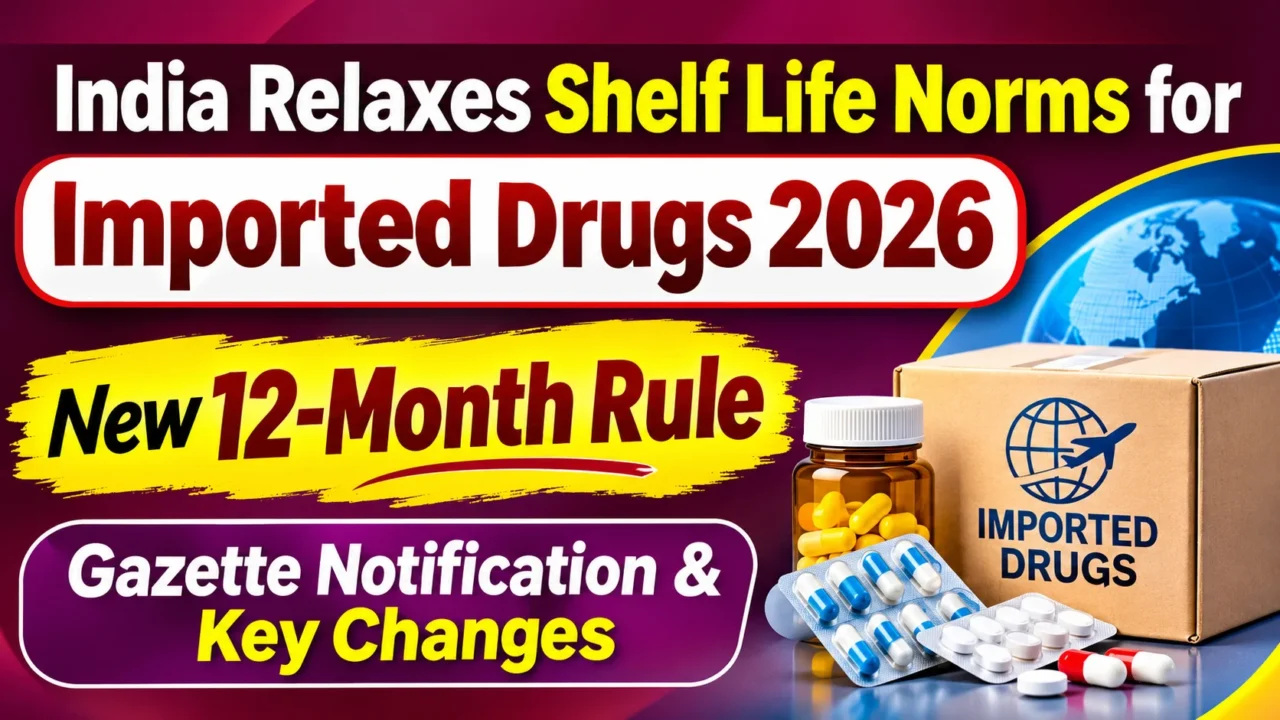

India’s Imported Drugs Shelf Life Rule 2026 has been amended by the Union Ministry of Health and Family Welfare to introduce a minimum residual shelf-life requirement of one year for imported drugs at the time of import. The change replaces the earlier requirement of more than 60% of the labelled shelf life for applicable imported medicines.
The amendment was notified through G.S.R. 951(E), dated 16 October 2026, under the Drugs (Thirteenth Amendment) Rules, 2026. It amends Rule 31 of the Drugs Rules, 1945, and came into force upon publication in the Official Gazette on 28 October 2026. cdsco.mohfw.gov.in+1
However, biological drugs and radiopharmaceuticals will continue to follow the 60% residual shelf-life requirement. The amendment aims to reduce avoidable medicine wastage, improve inventory utilisation and make pharmaceutical imports more efficient.
Imported Drugs Shelf Life Rule 2026 – Quick Summary
India has introduced a minimum one-year residual shelf-life requirement for applicable imported drugs under the amended Rule 31 of the Drugs Rules, 1945. The earlier 60% requirement has been replaced for these medicines. Biological drugs and radiopharmaceuticals retain the 60% requirement. The amendment took effect on 28 October 2026. Gazette Notification PDF+1

Imported Drugs Shelf Life Rule 2026 – Overview
| Particulars | Details |
|---|---|
| Issuing Authority | Union Ministry of Health and Family Welfare |
| Country | India |
| Notification Number | G.S.R. 951(E) |
| Notification Date | 16 October 2026 |
| Gazette Publication Date | 28 October 2026 |
| Amendment Name | Drugs (Thirteenth Amendment) Rules, 2026 |
| Relevant Regulation | Rule 31 of Drugs Rules, 1945 |
| Previous Requirement | More than 60% residual shelf life |
| New Requirement | Minimum 1 year residual shelf life |
| Biological Drugs | 60% of labelled shelf life |
| Radiopharmaceuticals | 60% of labelled shelf life |
| Regulatory Advisory Body | Drugs Technical Advisory Board (DTAB) |
| Effective Date | 28 October 2026 |
| Main Objective | Reduce medicine wastage and improve inventory utilisation |
cdsco.mohfw.gov.in+2
What Is the New 12-Month Shelf Life Rule for Imported Drugs?
Under the amended Rule 31 of the Drugs Rules, 1945, the licensing authority shall not allow the import of a drug having less than one year of residual shelf life on the date of import.
This means that applicable imported medicines must have at least 12 months of shelf life remaining when they enter India.
The amendment replaces the earlier percentage-based requirement with a fixed one-year requirement.
The important points are:
- Imported drugs must have at least 12 months of residual shelf life at the time of import.
- The new requirement applies to applicable imported drugs.
- Biological drugs and radiopharmaceuticals retain the 60% requirement.
- The amendment does not remove other regulatory requirements relating to medicine quality, safety and efficacy.
Gazette Notification PDF+1
Previous Rule vs New Imported Drug Shelf Life Rule 2026
The major change is the replacement of the earlier percentage-based requirement with a fixed minimum residual shelf life.
| Particulars | Previous Rule | Amended Rule |
|---|---|---|
| Residual Shelf Life | More than 60% of labelled shelf life | Minimum 1 year |
| Measurement | Percentage-based | Fixed duration |
| Applicable Drugs | Imported drugs | Applicable imported drugs |
| Biological Drugs | More than 60% | 60% may be allowed |
| Radiopharmaceuticals | More than 60% | 60% may be allowed |
| Legal Provision | Rule 31 | Amended Rule 31 |
Gazette Notification PDF+1
Which Drugs Will Continue to Follow the 60% Shelf Life Requirement?
The amended regulation provides exceptions for two specific categories of medicines.
1. Biological Drugs
Biological drugs are medicines derived from biological sources. Their stability can be affected by storage conditions, temperature and handling.
Therefore, the existing requirement of 60% of the labelled shelf life will continue to apply.
2. Radiopharmaceuticals
Radiopharmaceuticals contain radioactive substances and are used in diagnostic and therapeutic applications.
Due to their specialised nature and stability considerations, these products will also continue to follow the 60% residual shelf-life requirement.
| Drug Category | Applicable Residual Shelf Life |
|---|---|
| Other applicable imported drugs | Minimum 12 months |
| Biological drugs | 60% of labelled shelf life |
| Radiopharmaceuticals | 60% of labelled shelf life |
Gazette Notification PDF+1
Why Has the Government Changed the Imported Drug Shelf Life Rule?
The main objective of this amendment is to reduce avoidable medicine wastage and improve pharmaceutical inventory management.
Under the previous requirement, some imported medicines could fail to meet the 60% threshold even when they had sufficient usable shelf life remaining.
The revised requirement is expected to provide greater flexibility to pharmaceutical importers while ensuring that medicines have at least one year of residual shelf life when imported.

Major Benefits of the New Rule
1. Reduced Medicine Wastage
The revised requirement is expected to reduce the destruction of medicines due to restrictive residual shelf-life conditions.
2. Better Inventory Management
Pharmaceutical companies may manage their imported medicine inventories more efficiently.
3. Greater Import Flexibility
The fixed one-year requirement replaces the earlier percentage-based threshold for applicable imported drugs.
4. Improved Supply Chain Efficiency
The amendment is expected to improve medicine inventory utilisation and reduce avoidable costs.
5. Continued Medicine Quality Standards
The amendment changes the residual shelf-life requirement at import. Other applicable quality, safety and efficacy requirements remain in place.Press Information Bureau+1
Role of Drugs Technical Advisory Board (DTAB)
The Drugs Technical Advisory Board (DTAB) played an important role in the amendment process.
The revised rule was introduced after consultation with DTAB.
The regulatory process involved the following steps:
| Event | Date |
|---|---|
| Draft Amendment Notification | 22 June 2026 |
| Public Notification Made Available | 25 June 2026 |
| Public Suggestions and Objections | Invited for 30 days |
| Final Notification | 16 October 2026 |
| Gazette Publication | 28 October 2026 |
| Implementation | 28 October 2026 |
The government considered the objections and suggestions received on the draft notification before finalising the amendment. Gazette Notification PDF+1
Does the New Rule Apply to Drugs Exported from India?
The amendment discussed here specifically concerns the residual shelf-life requirement for imported drugs under Rule 31 of the Drugs Rules, 1945.
It should not be interpreted as automatically changing the shelf-life requirements applicable to drugs exported from India.
The existing export-related requirements should be checked separately under the applicable regulatory provisions.
The new amendment does not establish a revised export shelf-life requirement. Gazette Notification PDF+1
What Does the Amendment Mean for the Indian Pharmaceutical Industry?
The revised imported drug shelf-life requirement is an important regulatory development for pharmaceutical manufacturers, importers and regulatory affairs professionals.
The key implications include:
- A minimum one-year residual shelf life for applicable imported drugs.
- Continued 60% residual shelf-life requirements for biological drugs and radiopharmaceuticals.
- Improved flexibility in pharmaceutical import and inventory management.
- Potential reduction in avoidable medicine wastage.
- Continued compliance with other applicable drug quality and safety regulations.
The amendment may be particularly relevant to pharmaceutical importers, multinational pharmaceutical companies, regulatory affairs departments and drug licensing professionals.
Why Should Pharmacy Students and Professionals Know About This Amendment?
This regulatory update is important for pharmacy students and professionals preparing for competitive examinations and working in the pharmaceutical industry.
Understanding this amendment can help with:
- Pharmaceutical Jurisprudence: Knowledge of amendments to the Drugs Rules, 1945.
- Regulatory Affairs: Understanding drug import regulations and licensing requirements.
- Quality Assurance: Learning about residual shelf life and medicine stability.
- Pharmaceutical Industry: Understanding inventory management and import compliance.
- Competitive Exams: Preparing for questions related to recent pharmaceutical regulatory updates.
Students preparing for GPAT, Drug Inspector and Pharmacist examinations should keep track of important changes in pharmaceutical regulations.
Important Gazette Notification Details
The amendment was notified through G.S.R. 951(E) under the Drugs (Thirteenth Amendment) Rules, 2026.
| Particulars | Details |
|---|---|
| Gazette Notification | G.S.R. 951(E) |
| Notification Date | 16 October 2026 |
| Publication Date | 28 October 2026 |
| Amendment | Drugs (Thirteenth Amendment) Rules, 2026 |
| Amended Rule | Rule 31 |
| Parent Legislation | Drugs Rules, 1945 |
| Effective Date | 28 October 2026 |
| Issuing Ministry | Ministry of Health and Family Welfare |
Official Reference: CDSCO – Gazette Notifications
The official notification is listed as G.S.R. 951(E) on the CDSCO Gazette Notifications page. cdsco.mohfw.gov.in+1
Frequently Asked Questions (FAQs)
Q1. What is the new imported drug shelf-life rule in India in 2026?
The new rule requires applicable imported drugs to have a minimum residual shelf life of one year (12 months) at the time of import.
Q2. Which rule of the Drugs Rules, 1945 has been amended?
Rule 31 of the Drugs Rules, 1945 has been amended through the Drugs (Thirteenth Amendment) Rules, 2026.
Q3. What was the previous shelf-life requirement for imported drugs?
The previous requirement was more than 60% of the labelled shelf life remaining at the time of import.
Q4. Which Gazette notification introduced the new 12-month requirement?
The amendment was notified through Gazette Notification G.S.R. 951(E) dated 16 October 2026.
Q5. Do biological drugs follow the new 12-month shelf-life rule?
No. Biological drugs will continue to follow the 60% of labelled shelf-life requirement.
Q6. What is the residual shelf-life requirement for radiopharmaceuticals?
Radiopharmaceuticals may be allowed with 60% of their labelled shelf life remaining.
Q7. Why has the government changed the imported drug shelf-life requirement?
The main objectives are to reduce medicine wastage, improve inventory utilisation and increase efficiency in the pharmaceutical supply chain.
Q8. When did the new imported drug shelf-life rule become effective?
The amendment came into force on 28 October 2026, the date of its publication in the Official Gazette.
Q9. Which organisation recommended the change in shelf-life requirements?
The amendment was made after consultation with the Drugs Technical Advisory Board (DTAB).
Conclusion
The Imported Drugs Shelf Life Rule 2026 is an important regulatory change in India’s pharmaceutical sector.
The Union Health Ministry has amended Rule 31 of the Drugs Rules, 1945, introducing a minimum residual shelf life of 12 months for applicable imported drugs instead of the earlier 60% requirement.
However, biological drugs and radiopharmaceuticals will continue to follow the 60% residual shelf-life requirement.
This amendment is expected to reduce avoidable medicine wastage, improve inventory management and provide greater flexibility to pharmaceutical importers.
Pharmacy students, pharmaceutical manufacturers, importers and regulatory affairs professionals should understand this important update and stay informed about changes in India’s drug regulations.
For more pharmaceutical industry updates, drug regulatory news, government jobs and pharmacy examination updates, visit GDC Classes.
Recommended Products