



Published: October 2026
Category: Pharma News | Drug Safety Alert | CDSCO Updates
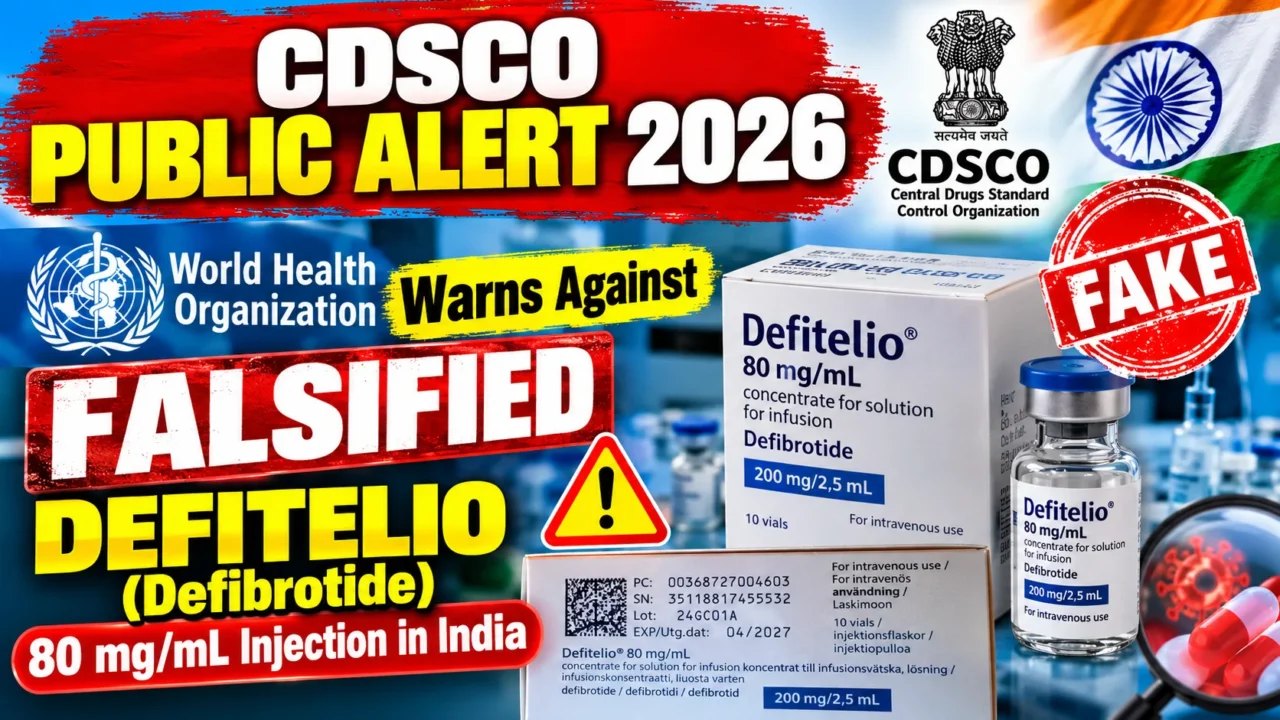
The CDSCO Defitelio Alert 2026 highlights concerns about a suspected falsified medicinal product reported in India. The product was presented as Defitelio (Defibrotide) 80 mg/mL concentrate for solution for infusion, with batch number 24GC01A and an expiry date of April 2027.
According to the alert details provided, the marketing authorisation holder identified discrepancies between the product packaging and an authentic reference sample. The company also confirmed that the specified batch had not been supplied to India.
The alert is important for pharmacists, doctors, hospital procurement teams, pharmacy students, and other healthcare professionals involved in medicine procurement, dispensing, and patient safety.
Quick Summary: CDSCO Defitelio Alert 2026
CDSCO has issued a public alert concerning suspected falsified Defitelio (Defibrotide) 80 mg/mL injection reported in India. The affected product bears batch number 24GC01A and an expiry date of April 2027. Packaging discrepancies were identified, and the manufacturer confirmed that this batch was not supplied to India. Healthcare professionals and consumers should avoid suspected falsified products and report concerns to the appropriate drug regulatory authority.

1. Overview of the CDSCO Public Alert
The Central Drugs Standard Control Organization (CDSCO), under the Directorate General of Health Services, Government of India, has highlighted a medicine authenticity concern following information received from the World Health Organization (WHO).
The product in question was presented as Defitelio 80 mg/mL concentrate for solution for infusion. An assessment of its packaging reportedly revealed differences from the authentic product.
The concern is not simply about the batch number. According to the alert, the packaging was fraudulent even though the batch and serial numbers corresponded to a genuine batch.
Key Highlights of the Alert
| Particulars | Details |
|---|---|
| Regulatory authority | Central Drugs Standard Control Organization (CDSCO) |
| Alert source | World Health Organization (WHO) |
| Product name | Defitelio |
| Generic name | Defibrotide |
| Strength | 80 mg/mL |
| Dosage form | Concentrate for solution for infusion |
| Batch number | 24GC01A |
| Serial number | 35118817455532 |
| Expiry date | April 2027 |
| Marketing authorisation holder | Gentium S.r.l., Italy |
| Manufacturer listed | Patheon, Italy |
| Country where the product was reported | India |
| Product status | Suspected falsified medicinal product |
| Alert period | October 2026 |
Note: Confirm these particulars against the original CDSCO alert and the accompanying WHO notification before publication.
2. What Is Defitelio (Defibrotide)?
Defitelio is a medicinal product containing defibrotide. It is supplied as a concentrate that is prepared for intravenous infusion under appropriate medical supervision.
Defibrotide is used for the treatment of severe hepatic veno-occlusive disease, also known as sinusoidal obstruction syndrome, in specific patients following haematopoietic stem-cell transplantation, according to the applicable product authorisation.
Because this medicine is administered by infusion for a serious medical condition, product authenticity, quality, and correct handling are particularly important.
A falsified medicine may contain the wrong ingredients, an incorrect concentration, no active ingredient, or other substances that have not been adequately assessed for safety and quality.
3. Details of the Suspected Falsified Defitelio Batch
Healthcare professionals and pharmacists should be aware of the identifying details reported in the alert.
| Product identification | Reported details |
|---|---|
| Product | Defitelio 80 mg/mL |
| Active ingredient | Defibrotide |
| Batch number | 24GC01A |
| Serial number | 35118817455532 |
| Expiry date | 04/2027 |
| Country of concern | India |
The alert states that Defitelio does not have marketing authorisation in India. The marketing authorisation holder also confirmed that the specified batch was intended for distribution in other countries and had never been supplied to India.
Important safety point: A batch number or serial number that matches a genuine product does not, by itself, prove that the medicine or its packaging is authentic.
4. How Was the Falsified Product Identified?
According to the alert information, the marketing authorisation holder, Gentium S.r.l., received an authenticity inquiry from India on 21 September 2026.
The company compared photographs of the reported product carton with an authentic retention sample. The comparison identified discrepancies in several packaging features.
Packaging discrepancies
The reported differences included:
- Text layout
- Font and typography
- Artwork
- Overall packaging presentation
Following this assessment, the marketing authorisation holder concluded that the reported product represented an attempt at falsification.
The company also confirmed that the specified batch had not been supplied to India.
This case demonstrates why medicine authentication should involve more than checking the printed batch number, serial number, or expiry date.
5. Potential Health Risks of Falsified Defitelio
The use of a suspected falsified medicine can compromise treatment and expose patients to avoidable risks.
Potential consequences include:
- Treatment failure: The product may not contain the expected active ingredient or may not meet the required quality standards.
- Delayed treatment: Patients may not receive the intended treatment when they need it.
- Uncertain safety: The identity, strength, quality, and safety of a falsified product may be unknown.
- Serious complications: Ineffective or inappropriate treatment can have serious consequences, particularly in patients with severe medical conditions.
These are potential risks associated with falsified medicines; they do not establish the actual composition of the reported product.
Patients and healthcare professionals should not use a product suspected of being falsified. Anyone who may have received or used it should contact the treating specialist or another qualified healthcare professional promptly for guidance.
6. CDSCO Advisory for Doctors and Healthcare Professionals
Doctors, pharmacists, nurses, and other healthcare professionals play an important role in preventing the use of falsified medicines.
The following precautions are recommended:
- Verify the authenticity of medicines obtained through supply channels.
- Purchase and procure medicines only from authorised and reliable suppliers.
- Examine packaging for unusual printing, layout, or artwork differences.
- Check batch details, expiry dates, invoices, and supplier documentation.
- Do not dispense or administer a product when its authenticity is in doubt.
- Report suspected falsified products to the appropriate drug regulatory authority.
- Follow applicable pharmacovigilance procedures for reporting suspected adverse drug reactions (ADRs).
If a patient may have received a suspect product, arrange appropriate clinical assessment and follow the relevant institutional and regulatory procedures.
7. Advisory for Pharmacists and Consumers
Pharmacists, hospital procurement teams, and consumers should remain alert when purchasing, receiving, storing, or dispensing medicines.
How to identify a potentially falsified medicine
| Safety check | What to look for |
|---|---|
| Packaging | Unusual printing, font, layout, spelling, or artwork |
| Batch number | Compare with official alerts and supplier records |
| Expiry date | Check that it is clearly printed and consistent |
| Serial number | Use only as one part of the verification process |
| Purchase invoice | Confirm the supplier and traceability of the transaction |
| Supply source | Purchase through authorised, reliable channels |
| Product concerns | Contact the manufacturer or relevant drug regulatory authority |
These checks can help identify warning signs, but visual inspection alone cannot establish a medicine’s authenticity.
What should you do if you find the suspected product?
- Do not dispense or use the suspected product.
- Keep it separate from usable stock and prevent accidental administration.
- Preserve the packaging, invoice, and supplier details where available.
- Inform the responsible pharmacist, hospital procurement team, or treating healthcare professional, as applicable.
- Report the concern to the appropriate State or District Drugs Control Authority.
- Follow the instructions of the relevant regulatory authority regarding product handling and submission of samples.
The alert information provided identifies dci@nic.in as an email address for reporting the matter to the relevant authority. Verify the contact details against the current official CDSCO notice before sending a report.
8. Has CDSCO Announced a Recall of Defitelio?
According to the accompanying rapid alert notification described in the supplied information, no product recall was being initiated at that time.
The notification reportedly stated that:
- There was no evidence available at that time that other units were affected.
- The marketing authorisation holder had not received a physical sample for laboratory testing.
- The investigation was ongoing.
These statements describe the situation reported at the time of that notification. They should not be interpreted as proof that the suspected product is safe or that the investigation has since been completed.
Current recall status: Not independently verified for this article. Readers should check the latest official CDSCO communication before making decisions about a specific product.
9. Important Regulatory Details at a Glance
| Question | Answer |
|---|---|
| Which product is involved? | Defitelio (Defibrotide) 80 mg/mL |
| What is the reported batch number? | 24GC01A |
| What is the expiry date? | April 2027 |
| Where was the product reported? | India |
| What raised concerns? | Differences between the reported packaging and an authentic reference sample |
| Was the batch supplied to India by the marketing authorisation holder? | No, according to the reported confirmation |
| Does a matching batch number guarantee authenticity? | No |
| What should healthcare professionals do? | Avoid using or dispensing suspected falsified products and report concerns to the appropriate authority |
| Was a recall initiated at the time of the accompanying notification? | No, according to the supplied notification details |
| Is the latest investigation status confirmed? | Not independently verified |
10. Why Is This Alert Important for Pharmacy Students?
The Defitelio alert provides a practical example of several important pharmacy concepts.
Key learning points
- Pharmaceutical quality assurance: Medicines must meet appropriate identity, strength, quality, and safety standards.
- Drug regulation: Regulatory authorities help identify and address suspected falsified medicinal products.
- Hospital pharmacy: Procurement and stock verification procedures help maintain medicine traceability.
- Pharmacovigilance: Healthcare professionals should report suspected adverse drug reactions through applicable reporting systems.
- Patient safety: Pharmacists have a responsibility to identify suspicious products and escalate concerns.
For B.Pharm, D.Pharm, and M.Pharm students preparing for pharmacy examinations, this alert can also be used as a current-affairs example when studying drug regulation, pharmaceutical quality assurance, hospital pharmacy, and pharmacovigilance.

11. Frequently Asked Questions (FAQs)
Q1. What is the CDSCO Defitelio Alert 2026?
The alert concerns a suspected falsified Defitelio (Defibrotide) 80 mg/mL concentrate for solution for infusion reported in India. The reported product had packaging discrepancies compared with an authentic reference sample.
Q2. What is the batch number of the suspected falsified Defitelio?
The reported batch number is 24GC01A, with an expiry date of April 2027. The serial number provided in the alert information is 35118817455532.
Q3. Why was the Defitelio product considered falsified?
The marketing authorisation holder reportedly identified differences in the carton’s text layout, font, artwork, and overall presentation when compared with an authentic retention sample.
Q4. Was the reported Defitelio batch supplied to India by the manufacturer?
According to the alert details, the marketing authorisation holder confirmed that the specified batch had never been supplied to India and was intended for distribution in other countries.
Q5. Is Defitelio authorised for marketing in India?
The supplied alert states that Defitelio does not have marketing authorisation in India. Readers should consult the original CDSCO communication for the exact regulatory wording and current status.
Q6. What should pharmacists do if they find this product?
Pharmacists should not dispense the suspected product. They should segregate it from usable stock, preserve relevant documentation, verify the supply chain, and report the concern to the appropriate drug regulatory authority.
Q7. Did CDSCO order a recall of the suspected Defitelio product?
The accompanying notification reportedly stated that no recall was being initiated at that time. The latest recall or investigation status has not been independently verified and should be checked against current official communications.
Q8. Where can suspected falsified medicines be reported?
Concerns should be reported to the appropriate State or District Drugs Control Authority. The supplied alert information also identifies dci@nic.in for necessary action; confirm the current reporting instructions on the official CDSCO website before submitting a report.
12. Official Sources and Further Reading
For accurate regulatory information, consult the original notice and verify the latest available updates before acting on the alert.
- CDSCO official website: https://cdsco.gov.in/
- World Health Organization: https://www.who.int/
- WHO medical product alerts: https://www.who.int/teams/health-product-policy-and-standards/medicines-selection-ip-and-affordability/medical-product-alerts
Publication note: Add a direct link to the specific CDSCO public alert and the corresponding WHO notification when their official URLs have been verified. The exact notification PDF link was not provided in the supplied material.
13. Related Articles on GDC Classes
Readers may also find the following topics useful:
- CDSCO drug safety alerts and regulatory updates
- Pharmacovigilance: adverse drug reaction reporting
- Pharmaceutical quality assurance and quality control
- Hospital pharmacy: medicine procurement and inventory management
- Important drug regulatory updates for pharmacy students
Internal linking note: Link these topics to relevant published articles on GDC Classes. Use the actual page URLs and descriptive anchor text; do not create links to pages that do not exist.
Conclusion
The CDSCO Defitelio Alert 2026 highlights the importance of verifying the authenticity of medicinal products and maintaining safe pharmaceutical supply chains. The reported Defitelio 80 mg/mL product carried batch number 24GC01A and showed packaging discrepancies when compared with an authentic reference sample.
The case also demonstrates that matching batch and serial numbers do not guarantee that a product is genuine. Doctors, pharmacists, hospitals, and consumers should remain vigilant, obtain medicines through authorised supply channels, and report suspected falsified products to the appropriate drug regulatory authorities.
For pharmacy students and healthcare professionals, this alert is a useful example of the practical importance of drug regulation, pharmaceutical quality assurance, and patient safety.
Stay updated with pharmaceutical news, drug safety alerts, and pharmacy education resources on GDC Classes.
Recommended Products