


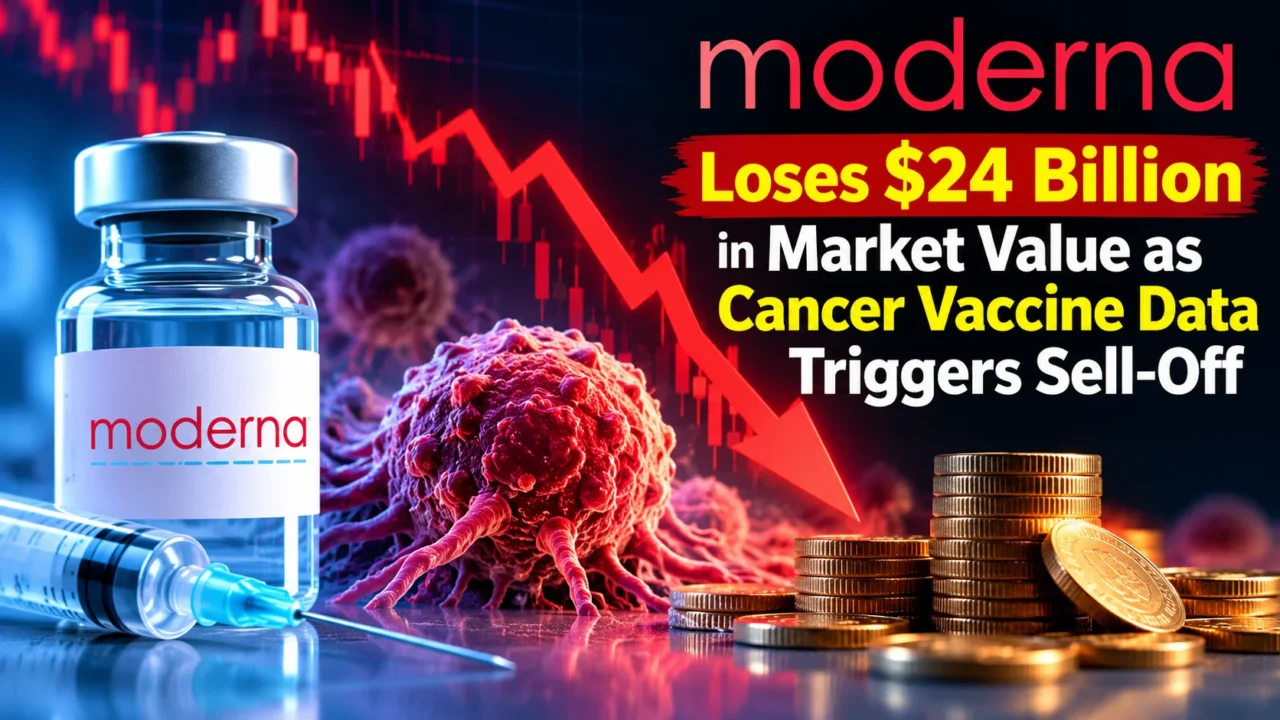

Moderna lost approximately $24 billion in market value on October 22, 2026, after its shares plunged more than 25% following the release of detailed Phase 3 melanoma cancer vaccine results. The Moderna cancer vaccine data 2026 attracted significant attention because the experimental personalized mRNA therapy showed promising results when combined with Merck’s Keytruda. However, investors reacted to the news by selling shares after a massive stock rally earlier in the year.
The development highlights the difference between positive clinical trial results and stock market expectations. It also marks an important milestone in the development of personalized mRNA-based cancer treatments.
Quick Summary
Moderna shares fell more than 25% on October 22, 2026, wiping out approximately $24 billion in market value. The sell-off followed detailed Phase 3 results for intismeran autogene, an experimental personalized mRNA cancer therapy developed with Merck. Combined with Keytruda, the treatment reduced the relative risk of melanoma recurrence or death by 42%. The vaccine remains investigational, and overall survival data are still developing.

Moderna Stock Fall 2026: Overview
Moderna, a biotechnology company known for its mRNA technology, experienced a sharp stock market decline after detailed clinical trial results for its personalized melanoma cancer vaccine became available.
The treatment, intismeran autogene, is being developed in collaboration with Merck. The Phase 3 INTerpath-001 trial evaluated the therapy alongside Keytruda (pembrolizumab) in patients with high-risk melanoma that had been surgically removed.
According to Reuters, Moderna shares dropped more than 25% on October 22, 2026. The decline erased approximately $24 billion from the company’s market value after its stock had gained more than 500% earlier in the year.
Key Details at a Glance
| Particular | Details |
|---|---|
| Company | Moderna, Inc. |
| Development partner | Merck |
| Experimental therapy | Intismeran autogene |
| Alternative development codes | V940 / mRNA-4157 |
| Combination drug | Keytruda (pembrolizumab) |
| Cancer type | High-risk melanoma |
| Clinical trial | Phase 3 INTerpath-001 |
| Trial participants | 1,137 patients |
| Reduction in risk of recurrence or death | 42% relative reduction |
| Reduction in risk of distant metastasis or death | 38% relative reduction |
| Stock market decline | More than 25% on October 22, 2026 |
| Estimated market value lost | Approximately $24 billion |
| Regulatory status | Investigational; approval not established |
| Source | Reuters report |
What Is Moderna’s Personalized Cancer Vaccine?
Moderna’s experimental cancer therapy is called intismeran autogene, also known as intismeran, V940 or mRNA-4157. It is an individualized neoantigen therapy designed to help the immune system recognize and attack cancer cells associated with a patient’s tumour.
The therapy is being developed with Merck and is intended to be used alongside Keytruda, an immunotherapy drug that helps the immune system fight cancer.
Unlike preventive vaccines that protect against infectious diseases, this experimental treatment is designed to support cancer treatment after a tumour has developed and been surgically removed.
How Does the mRNA Cancer Vaccine Work?
The treatment uses information about mutations in an individual patient’s tumour to develop a personalized therapeutic approach.
The process broadly involves:
- Tumour analysis: Genetic information from the patient’s tumour is analysed to identify relevant mutations.
- Personalized vaccine design: An mRNA-based treatment is designed to encode selected tumour-specific neoantigens.
- Immune-system activation: The vaccine aims to train the immune system to recognize these targets.
- Combination treatment: The vaccine is administered with Keytruda to support an immune response against cancer.
The goal is to reduce the likelihood of cancer returning or spreading following surgery. However, the treatment is still under investigation and is not established as a cure for melanoma.
Phase 3 INTerpath-001 Trial: Key Findings
The Phase 3 INTerpath-001 study enrolled 1,137 patients with completely resected, high-risk stage IIB–IV melanoma. It compared intismeran autogene plus Keytruda with Keytruda alone.
In August 2026, Moderna and Merck announced that the trial had met its primary endpoint of recurrence-free survival and a key secondary endpoint of distant metastasis-free survival. Detailed results reported in October provided further information about the treatment’s performance.
Main Clinical Trial Results
| Clinical outcome | Reported result |
|---|---|
| Recurrence-free survival | 42% relative reduction in the risk of recurrence or death |
| Distant metastasis-free survival | 38% relative reduction in the risk of distant metastasis or death |
| Comparison group | Keytruda alone |
| Overall survival | Data not yet mature |
| Safety findings | No new safety signals reported in the August company announcement |
Source: Merck and Moderna Phase 3 announcement.
What Does a 42% Reduction in Risk Mean?
A 42% relative reduction means that the combination treatment reduced the relative risk of melanoma recurrence or death by 42% compared with Keytruda alone during the reported analysis.
It does not mean that 42% of patients were cured or that the treatment reduced every patient’s individual risk by exactly 42%.
Similarly, the 38% figure represents a relative reduction in the risk of distant metastasis or death. These results are clinically important measures, but their interpretation depends on the study design, follow-up period and statistical analysis.
The trial is continuing to evaluate overall survival and other outcomes.
Why Did Moderna Stock Fall Despite Positive Cancer Vaccine Results?
The sharp decline appears to reflect investor expectations, profit-taking and uncertainty about the treatment’s future commercial potential rather than evidence that the clinical trial failed.
1. High Investor Expectations
Moderna’s shares had risen more than 500% during 2026 before the October sell-off, according to Reuters. Investors were anticipating detailed results from a major clinical milestone.
When expectations become exceptionally high, even encouraging results may fail to produce further gains if investors believe the positive news is already reflected in the stock price.
2. Sell-the-News Reaction
A sell-the-news reaction occurs when investors sell shares after an anticipated announcement becomes public.
Some investors may have purchased Moderna shares ahead of the clinical announcement and decided to lock in profits after the data became available. This type of trading can cause a stock price to fall even when the underlying news is positive.
3. Questions About Other Cancer Types
The reported Phase 3 results relate to high-risk melanoma. Investors may be uncertain whether the same personalized mRNA approach will demonstrate comparable benefits in other cancer types.
Success in one cancer indication does not automatically establish effectiveness across all cancers.
4. Regulatory and Commercial Uncertainty
Positive Phase 3 results are an important development, but they do not guarantee regulatory approval or commercial success.
Future decisions will depend on the complete clinical evidence, regulatory review, manufacturing capabilities, treatment costs, patient access and adoption in clinical practice.
5. Uncertainty About Long-Term Survival Benefits
The companies have reported favourable trends in overall survival, but the overall survival data remain immature. Longer follow-up is needed to understand whether the treatment improves survival over time.
These uncertainties can influence how investors assess a biotechnology company’s future revenue and valuation.

What Does the Cancer Vaccine Mean for Moderna’s Future?
The clinical results could support Moderna’s strategy of expanding beyond infectious-disease vaccines.
The company has invested in mRNA technology for multiple applications, including experimental cancer therapies. Its collaboration with Merck is an important example of combining personalized mRNA technology with an established immunotherapy.
If further evidence supports the treatment’s benefits and regulators approve it, intismeran autogene could become an important addition to treatment options for certain patients with high-risk melanoma.
However, the commercial impact remains uncertain. Regulatory outcomes, manufacturing requirements, pricing, treatment access and the results of ongoing follow-up will all influence its future prospects.
The October stock decline also demonstrates how clinical milestones can affect biotechnology valuations when investors have already priced in substantial future growth.
What Is the Difference Between Clinical Results and Stock Performance?
Clinical trial results and stock market performance measure different things.
| Clinical research | Stock market |
|---|---|
| Evaluates treatment safety and effectiveness | Reflects investor expectations about future value |
| Uses predefined endpoints and statistical analysis | Responds to news, valuations, trading and market conditions |
| Requires continued evaluation and regulatory review | Can fluctuate rapidly, even after positive announcements |
| Focuses on outcomes for patients | Focuses on expected financial returns and risk |
A positive clinical trial does not guarantee a rise in the company’s share price. Likewise, a stock price decline does not necessarily mean that a clinical trial has failed.
For Moderna, the reported results were encouraging, but investors were also assessing the company’s valuation and the future commercial potential of its cancer vaccine programme.
Important Developments to Watch
Readers following Moderna’s cancer vaccine programme should monitor the following developments:
- Full clinical data: Further details about recurrence-free survival, distant metastasis-free survival and adverse events.
- Overall survival: Additional follow-up to determine whether the combination improves overall survival.
- Regulatory progress: Updates from relevant regulatory authorities regarding potential submissions and review.
- Future clinical research: Evidence supporting the use of personalized mRNA therapies in other cancer types.
- Commercial outlook: Information about manufacturing, pricing, treatment access and potential market adoption.
The full trial results were scheduled for presentation at the European Society for Medical Oncology (ESMO) Congress 2026 in Madrid on October 24, according to the companies’ announcements.
Readers should consult company disclosures and official regulatory communications for confirmed updates.
Frequently Asked Questions (FAQs)
1. Why did Moderna lose $24 billion in market value in October 2026?
Moderna shares fell more than 25% on October 22, 2026, after detailed Phase 3 melanoma cancer vaccine results triggered a sell-the-news reaction following a substantial stock rally.
2. What is Moderna’s cancer vaccine called?
The experimental personalized mRNA cancer therapy is called intismeran autogene. It is also known as intismeran, V940 or mRNA-4157.
3. What were the main Phase 3 cancer vaccine results?
The combination of intismeran autogene and Keytruda reduced the relative risk of melanoma recurrence or death by 42% and the relative risk of distant metastasis or death by 38%, compared with Keytruda alone.
4. Who is developing Moderna’s cancer vaccine?
Moderna is developing intismeran autogene in collaboration with Merck. The experimental treatment is being evaluated in combination with Merck’s immunotherapy drug Keytruda (pembrolizumab).
5. Is Moderna’s cancer vaccine approved?
Intismeran autogene remains an investigational therapy in the information reported here. The clinical trial results do not by themselves establish regulatory approval or commercial availability.
6. Does the Moderna cancer vaccine cure melanoma?
The reported trial results do not establish a cure. They demonstrate reductions in the relative risks of recurrence or death and distant metastasis or death compared with Keytruda alone. Further follow-up is required.
7. What does a sell-the-news reaction mean?
A sell-the-news reaction occurs when investors sell a stock after an anticipated announcement becomes public. Selling to take profits or adjust expectations can cause the stock price to fall despite positive news.
8. What is the significance of Moderna’s Phase 3 trial?
The INTerpath-001 trial provides Phase 3 evidence for a personalized mRNA-based cancer therapy combined with immunotherapy in patients with high-risk melanoma. The results are an important research milestone, although long-term outcomes and regulatory decisions remain to be determined.
Conclusion
The Moderna cancer vaccine data 2026 attracted global attention after the company’s shares plunged more than 25%, wiping out approximately $24 billion in market value. Despite the sharp market reaction, the Phase 3 INTerpath-001 trial reported encouraging results for intismeran autogene combined with Keytruda in patients with high-risk melanoma.
The findings could advance personalized mRNA-based cancer treatment, but further follow-up and regulatory review will be necessary to determine the therapy’s eventual role in clinical practice.
For pharmacy students, researchers and healthcare professionals, the development offers an important example of how mRNA technology is being explored beyond infectious diseases and how clinical research findings differ from stock market reactions.
Recommended Products