


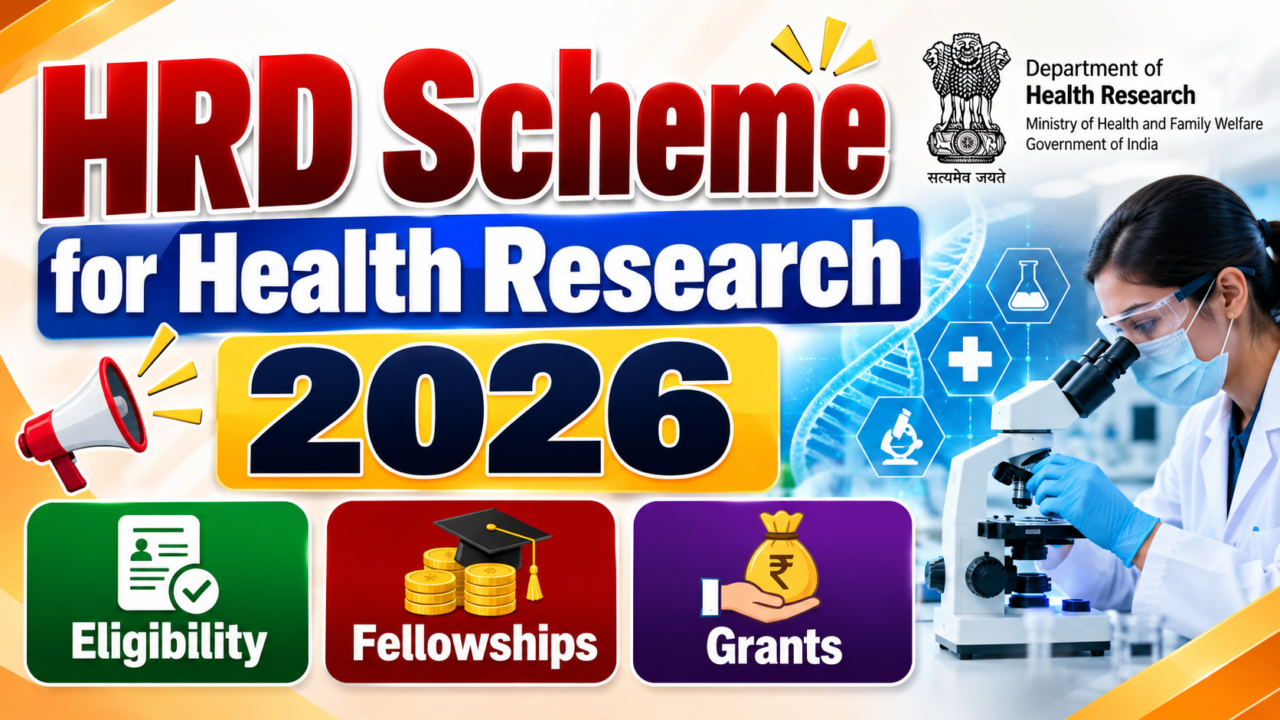

The HRD Scheme for Health Research is a Government of India initiative that supports biomedical research through fellowships, research grants, specialised training and institutional funding. The scheme is managed by the Department of Health Research (DHR), Ministry of Health & Family Welfare, with implementation through the Indian Council of Medical Research (ICMR).
The amended guidelines, dated 20 December 2025, describe multiple programmes for eligible medical students, postgraduate researchers, scientists, faculty members and research institutions. This article explains the scheme’s eligibility criteria, fellowship amounts, research grants, major benefits and application process.
HRD Scheme for Health Research 2026: Overview
| Particular | Details |
|---|---|
| Scheme Name | Human Resource Development Scheme for Health Research |
| Responsible Department | Department of Health Research (DHR) |
| Ministry | Ministry of Health & Family Welfare, Government of India |
| Implementing Agency | Indian Council of Medical Research (ICMR) |
| Guidelines Amended On | 20 December 2025 |
| Scheme Period Covered | 2021–22 to 2025–26 |
| Main Objective | Develop skilled human resources for biomedical and health research |
| Major Benefits | Fellowships, research grants, training and institutional support |
| Official Websites | DHR and ICMR |
Important update: The available guidelines cover the 15th Finance Commission period ending in 2025–26. A new application cycle or extension for 2026–27 is not confirmed by this document.
What Is the Objective of the HRD Scheme?
The scheme aims to strengthen India’s biomedical research workforce and improve research capabilities across medical colleges, universities and research institutions.
Its major objectives are:
- Increase the number of skilled health and biomedical researchers.
- Encourage medical graduates and research scholars to pursue research careers.
- Provide specialised training in priority research areas.
- Promote collaboration between researchers and institutions.
- Strengthen research infrastructure and online learning facilities.
- Encourage research addressing important national and local health problems.
List of Fellowships and Programmes Under the HRD Scheme

The amended guidelines list 15 major components.
| No. | Programme | Main Purpose |
|---|---|---|
| 1 | Short-Term Studentship (STS) | Introduce eligible medical and dental undergraduates to research |
| 2 | Thesis Support Programme | Support research by eligible medical and dental postgraduate students |
| 3 | Medical PhD Programme | Encourage doctoral research among eligible medical graduates and faculty |
| 4 | Biomedical Research Fellowships | Support doctoral research by eligible non-medical scholars |
| 5 | Short-Term Fellowship Abroad | Provide specialised overseas research training |
| 6 | Long-Term Fellowship Abroad | Support extended overseas research training |
| 7 | Short-Term Fellowship at Indian Institutes | Provide specialised training in India |
| 8 | Long-Term Fellowship at Indian Institutes | Support longer-duration research training in India |
| 9 | Women Scientists Fellowship | Help eligible women scientists return to research |
| 10 | NRI/PIO/OCI Research Support | Encourage eligible Indian-origin researchers abroad to conduct research in India |
| 11 | Best Achievement in Biomedical Research | Recognise outstanding biomedical research |
| 12 | International Travel Grant | Support eligible researchers attending international scientific events |
| 13 | Workshop Funding Grant | Support biomedical research workshops |
| 14 | Institutional Support | Improve research and training infrastructure |
| 15 | Start-Up Grant | Support independent biomedical research projects |
HRD Scheme Eligibility Criteria
There is no single eligibility criterion for every component. Applicants must meet the educational qualifications, age limits, experience requirements and other conditions specified for their selected programme.
Potential beneficiaries identified in the guidelines include:
- Undergraduate medical and dental students.
- Eligible postgraduate medical and dental students.
- Medical PhD candidates and faculty members.
- Postgraduate scholars from biomedical and related science backgrounds.
- Eligible scientists and researchers employed at recognised institutions.
- Women scientists seeking to return to research after a career break.
- Eligible NRI, PIO and OCI researchers.
- Recognised research institutions and scientific or professional associations.
Educational Qualifications
The qualifications vary by programme. The guidelines mention MBBS, BDS, MD, MS, MDS, PhD and certain postgraduate science and professional qualifications, including MPharm, MTech and MSc, in specified categories.
For pharmacy candidates: An MPharm qualification may be relevant to selected fellowship or training categories. However, it does not establish eligibility for every programme. Some categories also require a PhD, relevant work experience, regular faculty employment or other conditions.
Age Limit
Age limits depend on the specific programme.
| Programme | Age Requirement in the Guidelines |
|---|---|
| Medical PhD Programme | Up to 45 years |
| Biomedical Research Fellowships through BRET | Up to 35 years under the guidelines applicable from 1 April 2025 |
| Short-Term Fellowship Abroad | Below 57 years |
| Long-Term Fellowship Abroad | Below 45 years |
| Fellowships at Indian Institutes | Up to 45 years |
| Women Scientists Fellowship | 30–45 years |
| NRI/PIO/OCI Research Support | Below 45 years |
| Start-Up Grant | Maximum 45 years |
Age relaxation may apply to eligible categories under the relevant government rules and programme conditions.
Note: These are programme-specific criteria from the amended guidelines, not a universal age limit for the entire scheme.
HRD Scheme Fellowship Amount and Financial Benefits
The scheme provides different types of financial support, depending on the programme and the applicant’s eligibility.
| Programme | Financial Assistance Stated in the Guidelines |
|---|---|
| Short-Term Studentship (STS) | ₹60,000 total for six months of research work |
| Medical/Dental Thesis Support | ₹1 lakh one-time grant |
| Medical PhD Programme, Category 1 | Eligible candidates without a parent-institution salary/stipend may receive ₹83,000 or ₹96,000 per month, depending on qualifications and conditions |
| Young Medical Faculty PhD | Research grant up to ₹50 lakh |
| BRET Fellowship | JRF ₹37,000/month; SRF ₹42,000/month, plus HRA where applicable |
| Short-Term Fellowship Abroad | US$3,000/month, subject to conditions |
| Long-Term Fellowship Abroad | US$3,000/month, subject to conditions |
| Short-Term Fellowship at Indian Institutes | Up to ₹40,000/month |
| Long-Term Fellowship at Indian Institutes | ₹40,000/month |
| Women Scientists Fellowship, Category A | ₹90,000/month for medical candidates; ₹67,000/month plus HRA for non-medical candidates |
| Women Scientists Fellowship, Category B | ₹65,000/month for medical candidates; ₹48,000/month plus HRA for non-medical candidates |
| NRI/PIO/OCI Research Support | ₹1.2 lakh/month for three years |
| Best Achievement in Biomedical Research | ₹1 lakh one-time fellowship |
| International Travel Grant | Up to ₹1.5 lakh |
| Biomedical Research Workshop Grant | Up to ₹10 lakh per workshop |
| Institutional Support | Up to ₹25 lakh for infrastructure and up to ₹10 lakh/year for five years for specified expenses |
| Start-Up Grant | ₹16 lakh/year, up to ₹48 lakh over three years |
All amounts are subject to the applicable programme rules, selection, budget availability and approval. They should not be interpreted as guaranteed payments to every applicant.
Important HRD Scheme Programmes Explained
1. Short-Term Studentship (STS)
The STS programme promotes research interest among eligible MBBS and BDS students.
Key details:
- Eligible students: First- and second-professional-year MBBS/BDS students in recognised Indian colleges.
- Research duration: Six months of work spread across three consecutive years during academic breaks.
- Total stipend: ₹60,000.
- Selection: Online application, research concept note evaluation and review of the final report.
Students from paramedical and non-medical courses are not eligible for this component under the stated guidelines.
2. Medical and Dental Thesis Support
This programme provides financial assistance to eligible medical and dental postgraduate students conducting thesis research.
Key details:
- Maximum age: 45 years.
- Application: Within one year of postgraduate admission or joining.
- Financial assistance: ₹1 lakh in two instalments.
- Final instalment: Subject to submission of an eligible original research publication arising from the thesis within the prescribed period.
3. Medical PhD Programme
The programme supports eligible medical graduates and young medical faculty members pursuing doctoral research.
For Category 1, the guidelines specify research funding of ₹10 lakh per year for the approved duration. Eligible candidates who are not receiving a salary or stipend from their parent institution may receive a monthly stipend according to their qualifications and the programme rules.
For Category 2, eligible young medical faculty members may receive a research grant of up to ₹50 lakh over five years or until PhD completion, whichever is earlier. No stipend is provided under this category.
4. Biomedical Research Fellowship Through BRET
The Biomedical Research Eligibility Test (BRET) route supports eligible postgraduate scholars pursuing doctoral research in biomedical and health sciences.
The guidelines specify:
- JRF remuneration of ₹37,000 per month plus applicable HRA.
- SRF remuneration of ₹42,000 per month plus applicable HRA, subject to the prescribed assessment and upgradation conditions.
- Contingency support of ₹20,000 per year.
- Fellowship duration and progression according to the scheme rules.
Candidates should confirm the current BRET notification, examination details and application dates separately.
5. Women Scientists Fellowship
The fellowship supports eligible unemployed women scientists who wish to resume their research careers following a qualifying career break.
Applicants must meet the relevant qualifications, age criteria, career-break conditions and host-institution requirements.
The scheme specifies different stipend amounts and durations for Category A and Category B, together with research funding of up to ₹10 lakh per year.
6. Start-Up Grant for Biomedical Research
The Start-Up Grant helps eligible researchers establish independent biomedical and health research projects.
Key details:
- Applicant must be a regular faculty member or scientist at an eligible Indian institution.
- The PhD in biomedical sciences must have been completed within the five years preceding the opening date of the application call.
- Maximum age: 45 years, subject to applicable relaxations.
- Financial assistance: Up to ₹48 lakh over three years.
Applicants receiving a major external or extramural research grant at the time of application are ineligible under the stated guidelines.

Why Should Pharmacy Candidates Check This Scheme?
The HRD Scheme may be relevant to pharmacy researchers interested in biomedical sciences, drug research and related interdisciplinary fields.
The research areas mentioned in the guidelines include:
- Drug chemistry and toxicology.
- Biotechnology and modern biology.
- Genetics, genomics and proteomics.
- Quality control and quality assurance.
- Good Clinical Practices (GCP).
- Good Laboratory Practices (GLP).
- Clinical pharmacology and related health research.
MPharm graduates, PhD scholars and eligible pharmacy faculty members can examine the relevant categories to determine whether their qualifications and research topics meet the conditions.
Important: The scheme is not a general pharmacy recruitment programme. It does not, by itself, announce pharmacist vacancies or guarantee a fellowship to every BPharm, DPharm or MPharm candidate.
How to Apply for the HRD Scheme
The application method depends on the selected programme. Follow these general steps:
- Visit the official Department of Health Research website.
- Find the latest notification for the relevant fellowship or grant.
- Read the eligibility, age limit, experience requirements and funding conditions.
- Prepare the required documents, such as educational certificates, CV, research proposal and institutional endorsement, where applicable.
- Submit the application through the portal or route specified in the official notification.
- Complete any required examination, interview, proposal review or technical evaluation.
- Check official announcements and registered email for selection results and further instructions.
Documents Required
The exact documents vary by programme. Depending on the category, applicants may need:
- Educational qualification certificates.
- Proof of age and citizenship, where required.
- Curriculum vitae.
- Research proposal or concept note.
- Experience certificates.
- Institutional endorsement or host-institution acceptance.
- Supporting publications and research records.
- Other declarations or documents specified in the notification.
Do not assume that every document is required for every programme. Follow the relevant application instructions.
Important Dates
| Event | Date |
|---|---|
| Guidelines amended on | 20 December 2025 |
| Scheme period covered | 2021–22 to 2025–26 |
| Current application opening date | Not mentioned in the official notification document provided |
| Current application last date | Not mentioned in the official notification document provided |
| Current selection result date | Not mentioned in the official notification document provided |
Applicants should consult the latest programme-specific notice for current dates.
Vacancy Details and Salary
The HRD Scheme is primarily a research fellowship and grant programme, not a conventional recruitment notification.
- Vacancies: Not mentioned in the official notification document as a single recruitment vacancy count. Individual components may have separate limits or selection numbers.
- Salary: Not applicable as a single scheme-wide salary. Eligible fellowships provide stipends or research funding according to the specific programme.
- Selection process: Depends on the category and may involve application screening, entrance examinations, expert review, interviews or technical evaluation.
Applicants should distinguish between fellowship stipends, research grants and regular employment salaries.
Important Links
| Resource | Link |
|---|---|
| Department of Health Research | Visit Official Website |
| Indian Council of Medical Research | Visit Official Website |
| Official HRD Scheme Guidelines | Refer to the amended guidelines dated 20 December 2025 provided with this article |
| Current Application Form | Check the latest programme-specific notification |
| Current Application Dates | Check the latest official announcement |
The supplied PDF does not provide a verified direct URL for a current application form or active application window. Applicants should not rely on unofficial dates or links.
Frequently Asked Questions (FAQs)
1. What is the HRD Scheme for Health Research?
The HRD Scheme is a Government of India initiative that supports biomedical and health research through fellowships, research grants, specialised training and institutional assistance.
2. Who can apply for the HRD Scheme?
Eligibility depends on the programme. Beneficiaries may include eligible medical and dental students, postgraduate researchers, scientists, faculty members, women researchers returning after a career break and qualifying research institutions.
3. Can MPharm candidates apply for the HRD Scheme?
MPharm is listed among the qualifications relevant to certain programme categories. Candidates must check whether the chosen category also requires a PhD, research experience, regular faculty employment or other qualifications.
4. What is the maximum financial assistance under the Start-Up Grant?
The guidelines specify ₹16 lakh per year, up to ₹48 lakh per project over three years, subject to eligibility and approval.
5. What is the fellowship amount under BRET?
The guidelines specify ₹37,000 per month plus applicable HRA for JRF and ₹42,000 per month plus applicable HRA for SRF, subject to the prescribed conditions.
6. Is the HRD Scheme accepting applications in 2026?
The supplied guidelines do not confirm an active application window for 2026–27. Check the latest notifications on the official DHR and ICMR websites.
7. Does the scheme offer fellowships abroad?
Yes. It includes short-term overseas fellowships of 15 days to three months and long-term fellowships of six to twelve months for eligible applicants.
8. Is the HRD Scheme a government pharmacist recruitment programme?
No. It is a research development scheme. It should not be confused with pharmacist recruitment notifications issued by government hospitals, medical colleges or other public-sector organisations.
Conclusion
The HRD Scheme for Health Research offers research and training opportunities for eligible candidates across several biomedical and health research disciplines. Its major components cover student research, doctoral fellowships, international training, women scientists, institutional support and independent research grants.
Pharmacy researchers and MPharm candidates should review the relevant eligibility criteria before applying. Since the available guidelines cover the 2021–22 to 2025–26 period, always verify the latest programme notification, application dates and funding conditions through the official DHR and ICMR websites.
Recommended Products