


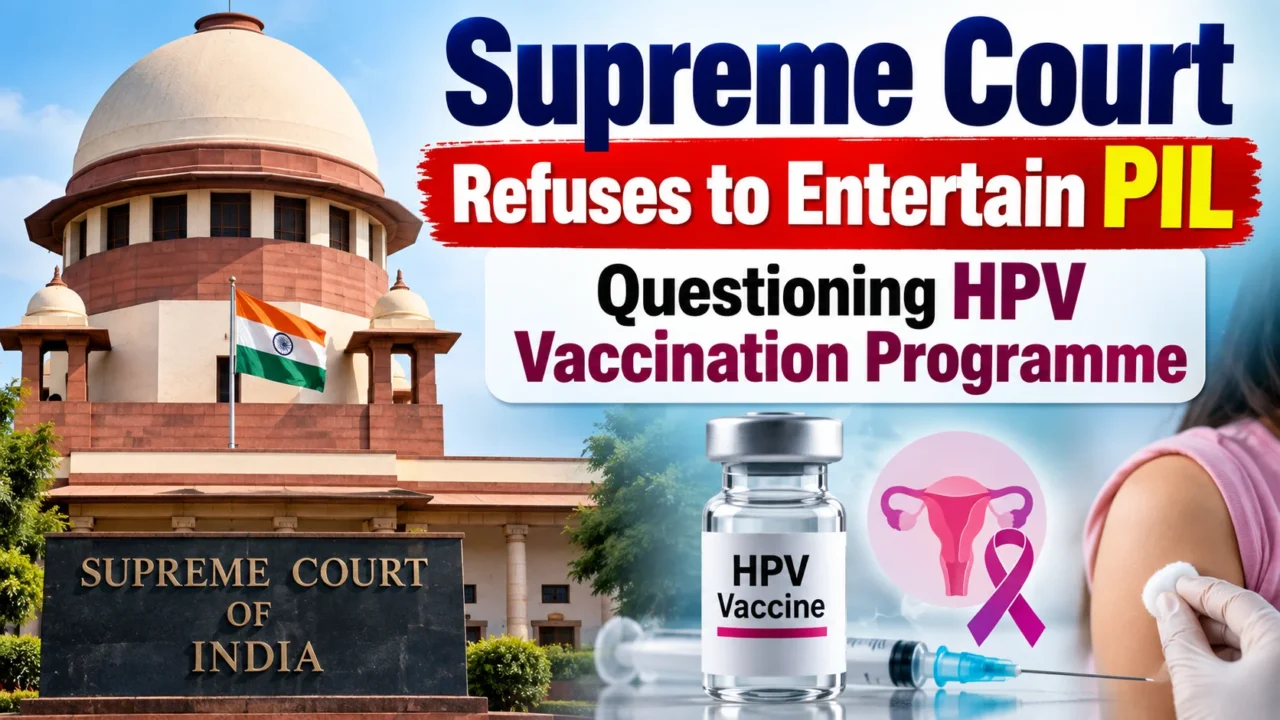

The Supreme Court HPV Vaccination Programme case involved a Public Interest Litigation (PIL) concerning the implementation of the Centre’s HPV vaccination programme for adolescent girls. The petition raised questions about informed consent, adverse-event monitoring, risk disclosure and compensation for vaccine-related injuries.
The petitioner clarified that the PIL was not an objection to vaccination itself, but focused on safeguards and accountability associated with the implementation of the HPV vaccination programme. The PIL was subsequently withdrawn following observations by the Supreme Court.
Quick Summary
The Supreme Court heard a PIL concerning the implementation of India’s HPV vaccination programme for adolescent girls. The petition raised concerns about informed consent, adverse-event monitoring, risk disclosure and compensation. The Court cautioned against unsupported vaccine claims and noted that existing compensation laws would apply where an adverse effect was established. The PIL was later withdrawn.

Supreme Court on HPV Vaccination Programme
A three-judge bench comprising Chief Justice of India Surya Kant, Justice Joymalya Bagchi and Justice V. Mohana heard the petition filed by the Universal Health Organisation (UHO).
The petition focused on the implementation of the HPV vaccination programme rather than opposing HPV vaccination itself.
The concerns raised were mainly related to the procedures, safety safeguards and accountability mechanisms associated with the programme.
What Was the PIL About?
The PIL questioned certain aspects of the implementation of the HPV vaccination programme.
The major concerns mentioned in the petition included:
- Monitoring of adverse events after HPV vaccination
- Obtaining informed consent
- Disclosure of potential risks
- Availability of a compensation mechanism for vaccine-related injuries
These issues relate to how vaccination programmes are implemented and how safety concerns are addressed.
Key Concerns Raised in the PIL
1. Adverse-Event Monitoring
The petitioner raised questions about the monitoring of adverse events following HPV vaccination.
Safety monitoring is an important part of any large-scale vaccination programme because it helps identify and assess health events occurring after vaccination.
2. Informed Consent
The petition also raised concerns about informed consent.
The issue involved whether individuals or their guardians receive appropriate information before vaccination, particularly in the context of an adolescent vaccination programme.
3. Disclosure of Risks
Another concern was whether relevant information about potential risks was adequately communicated before vaccination.
4. Vaccine Injury Compensation
The petition also raised the issue of compensation for injuries allegedly associated with vaccination and questioned the availability of a specific compensation mechanism.
Supreme Court’s Observations on HPV Vaccine Claims
During the hearing, the Supreme Court cautioned against making unsubstantiated claims about vaccines.
The Court indicated that claims without adequate scientific support could undermine or derail a public health programme.
The Court also observed that existing laws governing compensation would apply where an adverse effect was established.
These observations were made in the context of the HPV vaccination programme and the concerns raised by the petitioner.

Was the Supreme Court Against HPV Vaccination?
No. The proceedings described in the case were not a Supreme Court declaration against HPV vaccination.
The petitioner’s counsel clarified that the PIL was focused on the implementation of the vaccination programme, including safeguards such as consent, safety monitoring, risk communication and compensation.
The Court’s observations also stressed the importance of adequate scientific evidence when making claims about vaccines.
Why Is HPV Vaccination Important?
Human Papillomavirus (HPV) infection is associated with cervical cancer. HPV vaccination is therefore an important preventive-health measure aimed at reducing HPV infections and the future burden of cervical cancer.
The Centre’s vaccination programme for adolescent girls is intended to support prevention of HPV-related disease.
The case also highlights the importance of maintaining appropriate safeguards while implementing large-scale public health programmes.
PIL Was Withdrawn
Following the Court’s observations, the petitioner sought permission to withdraw the PIL.
The matter was subsequently withdrawn, and the Supreme Court did not proceed further with the petition on the issues raised in the PIL.
Key Details of the Supreme Court HPV Vaccination PIL
| Particular | Details |
|---|---|
| Case Type | Public Interest Litigation (PIL) |
| Petitioner | Universal Health Organisation (UHO) |
| Main Issue | Implementation of the HPV vaccination programme |
| Major Concerns | Adverse-event monitoring, informed consent, risk disclosure and compensation |
| Bench | CJI Surya Kant, Justice Joymalya Bagchi and Justice V. Mohana |
| Programme | HPV vaccination programme for adolescent girls |
| Court’s Observation | Caution against unsupported claims about vaccines |
| Compensation Observation | Existing laws apply where an adverse effect is established |
| Outcome | PIL withdrawn |
Why Is This Case Important for Pharmacy Students?
The case is relevant for pharmacy and healthcare students because it highlights important concepts related to:
- Vaccine safety
- Pharmacovigilance
- Adverse-event monitoring
- Informed consent
- Risk communication
- Public health programmes
- Evidence-based healthcare
For pharmacy students preparing for competitive examinations, these topics can also be useful for understanding the broader role of medicines, vaccines and pharmacovigilance in public health.
Important Takeaways
- The Supreme Court heard a PIL concerning the implementation of the HPV vaccination programme.
- The petition was filed by the Universal Health Organisation (UHO).
- The petitioner raised concerns about informed consent, adverse-event monitoring, risk disclosure and compensation.
- The petitioner clarified that the PIL was not an objection to vaccination itself.
- The Supreme Court cautioned against unsubstantiated claims about vaccines.
- The Court observed that existing compensation laws would apply where an adverse effect was established.
- The PIL was subsequently withdrawn.
FAQs on Supreme Court HPV Vaccination Programme
1. What was the Supreme Court HPV vaccination PIL about?
The PIL questioned aspects of the implementation of the HPV vaccination programme, including informed consent, safety monitoring, risk disclosure and compensation.
2. Who filed the HPV vaccination PIL?
The petition was filed by the Universal Health Organisation (UHO).
3. Did the PIL oppose HPV vaccination?
No. According to the information provided, the petitioner’s counsel clarified that the concerns were about the implementation and safeguards of the programme, rather than opposition to vaccination itself.
4. What concerns were raised about HPV vaccination?
The concerns included adverse-event monitoring, informed consent, disclosure of risks and compensation for vaccine-related injuries.
5. What did the Supreme Court say about vaccine claims?
The Court cautioned against making unsubstantiated claims about vaccines and highlighted the importance of adequate scientific support.
6. What did the Supreme Court say about compensation?
The Court observed that existing laws governing compensation would apply where an adverse effect was established.
7. What was the outcome of the HPV vaccination PIL?
The petitioner sought permission to withdraw the PIL following the Court’s observations, and the matter was subsequently withdrawn.
8. Why is HPV vaccination important?
HPV infection is associated with cervical cancer, so HPV vaccination is an important preventive-health measure aimed at reducing HPV infections and the associated disease burden.
Important Note
The detailed Supreme Court order/case document was not provided with the source content used for this article. Therefore, readers should refer to the verified court record or an official source for the complete legal details.
Important Links
| Resource | Details |
|---|---|
| Supreme Court of India | Official Supreme Court website |
| Case/Order | Add the verified official Supreme Court case/order link before publishing |
| HPV Vaccination Information | Add a verified official government health source if referenced |
Publishing note: Insert the exact official Supreme Court order/case URL and verified government HPV programme source rather than using an unverified third-party link.
Conclusion
The Supreme Court HPV Vaccination Programme proceedings focused on concerns about the implementation of the programme rather than opposition to HPV vaccination itself. The PIL raised issues related to informed consent, adverse-event monitoring, risk disclosure and compensation.
The Supreme Court cautioned against claims about vaccines that are not supported by adequate scientific evidence and observed that existing compensation laws would apply where an adverse effect was established. The petitioner subsequently withdrew the PIL.
For pharmacy and healthcare students, the case provides useful context on vaccine safety, pharmacovigilance, informed consent, evidence-based healthcare and public health programmes.
Recommended Products