


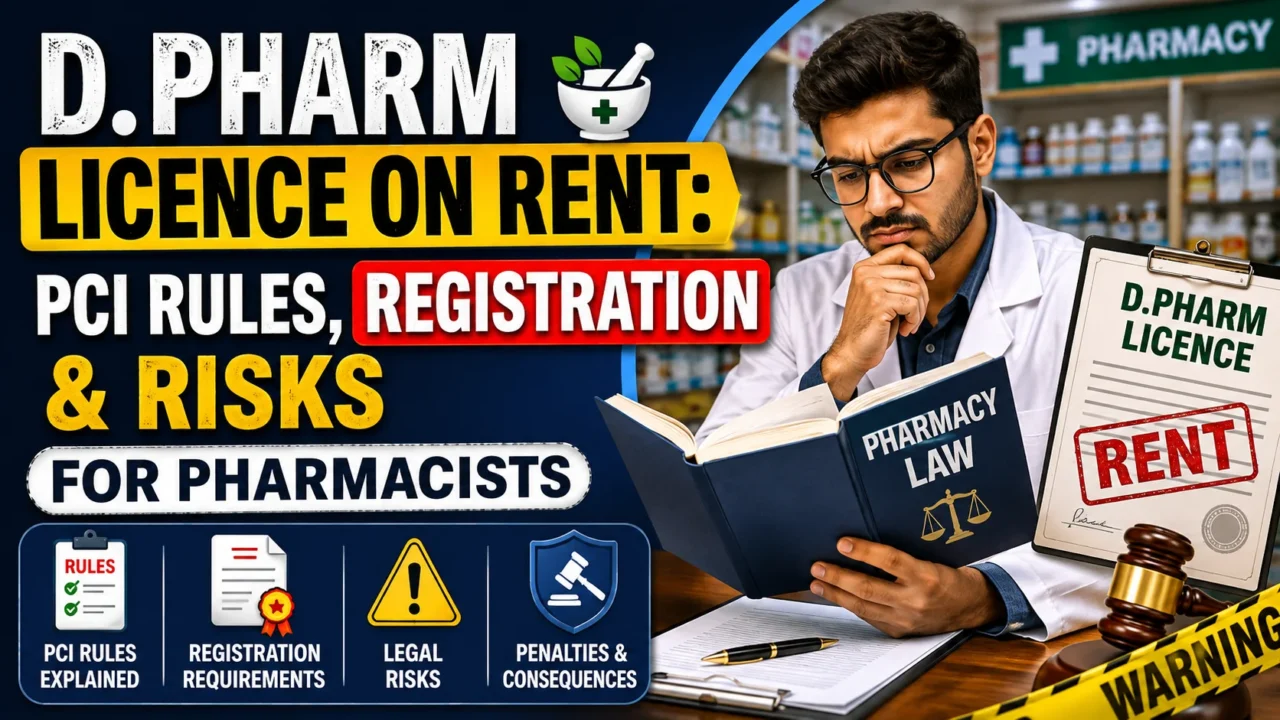

Can a D.Pharm pharmacist give their licence or registration on rent to a pharmacy? Can pharmacist registration be cancelled for misuse? What does the Pharmacy Council of India say?
These questions have become important for pharmacy professionals after claims circulated about strict action against pharmacists who allow their professional credentials to be used by another person.
Before believing any viral post or newspaper headline, pharmacists should understand the difference between pharmacist registration, pharmacy/drug licences and professional responsibility.
The Pharmacy Council of India (PCI) is the statutory body under the Ministry of Health & Family Welfare, while pharmacist registration is carried out by State Pharmacy Councils, not directly by PCI.
Quick Summary
A D.Pharm licence on rent generally refers to allowing a pharmacist’s registration or professional credentials to be used by a pharmacy without the pharmacist actually performing the required professional duties. Pharmacist registration is handled by State Pharmacy Councils. Under the Pharmacy Act, disciplinary action, including removal from the register in specified circumstances, is possible after due process. Pharmacists should therefore avoid lending or misusing their professional credentials.

What Does “D.Pharm Licence on Rent” Mean?
The term “D.Pharm licence on rent” is commonly used to describe an arrangement where a registered pharmacist allows their name, registration or professional credentials to be associated with a pharmacy in return for payment, even though the pharmacist may not actually be working there or fulfilling the required professional responsibilities.
In simple terms, the pharmacist’s credentials may be used mainly to satisfy a regulatory requirement.
This can create serious compliance concerns because pharmacist registration represents a professional qualification and responsibility, not simply a document that can be rented to a business.
Is D.Pharm Registration the Same as a Pharmacy Licence?
No.
This is one of the most important points pharmacists and pharmacy students should understand.
| Term | Meaning |
|---|---|
| D.Pharm | Diploma in Pharmacy qualification |
| Pharmacist Registration | Professional registration with the relevant State Pharmacy Council |
| Drug/Pharmacy Licence | Licence associated with the legal operation of a drug-selling establishment |
| PCI | Pharmacy Council of India |
| State Pharmacy Council | Authority responsible for pharmacist registration at the state level |
PCI’s official FAQ states that registration, renewal and transfer of pharmacist registration are handled by State Pharmacy Councils, rather than PCI.
Therefore, using the phrase “D.Pharm licence” can sometimes create confusion. In many situations, the actual document being discussed is the pharmacist’s registration, not the D.Pharm qualification itself.

Can a Pharmacist Give Their Registration on Rent?
A pharmacist should not treat professional registration as something that can simply be rented to another person or business.
Registration is connected with the pharmacist’s professional status and responsibilities.
PCI’s FAQ confirms that D.Pharm from a PCI-approved institution is an approved qualification for registration as a pharmacist, subject to the applicable statutory requirements.
The Pharmacy Act also provides provisions under which the name of a registered pharmacist can be removed from the register in specified circumstances, following the prescribed process and opportunity to be heard.
What Does the Pharmacy Act Say About Removal from the Register?
The Pharmacy Act, 1948 contains provisions regarding removal of a registered pharmacist’s name from the register.
According to Section 36 of the Act, removal may be ordered in specified circumstances, including cases involving:
- Entry into the register due to error, misrepresentation or suppression of a material fact.
- Conviction for an offence or professional misconduct considered serious enough to make the pharmacist unfit to remain registered.
- Certain misconduct connected with a person employed in a pharmacy business, where the statutory conditions relating to the registered pharmacist are satisfied.
Importantly, the Act provides for an opportunity of being heard and further inquiry where applicable. Therefore, it would be inaccurate to claim that every pharmacist who is accused of “renting a licence” will automatically lose registration.
The exact action depends on the facts, applicable provisions and the competent authority.
Who Registers a Pharmacist in India?
Pharmacist registration is not directly performed by PCI.
According to PCI’s official FAQ:
- Registration is conducted by the State Pharmacy Councils.
- Registration is carried out under the relevant provisions of the Pharmacy Act, 1948.
- Applicants must meet the prescribed statutory requirements.
- D.Pharm, B.Pharm and Pharm.D are among the qualifications recognised for pharmacist registration when obtained under the applicable PCI-approved conditions.
PCI also maintains a list of State Pharmacy Councils through its official website.
What Are the Risks of Giving Your Pharmacist Registration to Someone Else?
The consequences depend on the facts and the applicable state and central regulations.
However, allowing professional credentials to be misused can expose a pharmacist to potential regulatory and professional action.
Possible concerns may include:
1. Disciplinary proceedings
A State Pharmacy Council may examine whether the pharmacist has breached applicable professional or statutory requirements.
2. Removal from the register
The Pharmacy Act contains provisions for removal of a registered pharmacist’s name in specified circumstances after following the required procedure.
3. Problems during inspection
If a pharmacy’s records show a registered pharmacist but the pharmacist is not actually fulfilling the expected professional role, this may raise questions during regulatory inspection.
4. Drug licence-related consequences
Depending on the facts and applicable drug-control requirements, action may also affect the pharmacy or drug licence.
5. Professional reputation
A pharmacist’s registration is linked to their professional identity. Any regulatory proceeding can therefore have long-term professional consequences.
Is the D.Pharm Licence Automatically Cancelled?
Not necessarily.
This distinction is important.
A headline may say:
“D.Pharm licence cancelled for giving it on rent.”
But a pharmacist should not interpret this as meaning that every such case automatically results in cancellation.
The actual consequence depends on:
- The nature of the violation
- The pharmacist’s conduct
- Applicable Pharmacy Act provisions
- State Pharmacy Council rules
- Drug-control regulations
- Evidence available in the case
- The decision of the competent authority
The Pharmacy Act itself provides a procedure for removal from the register, including an opportunity to be heard.
Therefore, pharmacists should verify the original official order/notification before relying on a specific claim about cancellation.
PCI vs State Pharmacy Council: Who Does What?
Understanding the regulatory structure can prevent confusion.
| Authority | Main Role |
|---|---|
| Pharmacy Council of India (PCI) | Pharmacy education, standards and national regulatory functions under the Pharmacy Act |
| State Pharmacy Council | Registration, renewal and transfer of registered pharmacists |
| Drug Control Authority | Drug licensing and enforcement-related functions |
| Pharmacist | Responsible for complying with professional and applicable regulatory requirements |
PCI itself states that registration, renewal and transfer of registration are handled by State Pharmacy Councils.
Why Should Pharmacy Candidates Take This Seriously?
For D.Pharm, B.Pharm and Pharm.D students and registered pharmacists, professional registration is more than a formality.
A pharmacist’s registration is connected with the legal practice of the profession.
PCI’s current information also shows continued emphasis on improving the pharmacist registration system. Its 2026 registration reforms describe the move toward more centralised digital processes, including digital tracking and identity-verification measures.
This makes it even more important for pharmacists to maintain accurate records and use their professional credentials responsibly.
What Should a Registered Pharmacist Do?
If you are a registered pharmacist, follow these precautions:
Do not lend your registration credentials
Do not allow another person or business to use your professional registration simply in exchange for a monthly payment.
Verify where your registration is being used
If your name appears in pharmacy-related documents, make sure you understand the purpose and your actual responsibilities.
Maintain employment records
Keep appointment letters, employment records and other relevant documents where applicable.
Check your State Pharmacy Council rules
Registration-related requirements can involve the State Pharmacy Council. PCI provides a list of State Pharmacy Councils on its website.
Verify official notifications
If you receive a message claiming that PCI has cancelled or changed a particular pharmacist rule, check the original notification on the official PCI website before sharing it.
Is D.Pharm Still a Valid Qualification for Pharmacist Registration?
Yes, subject to the applicable statutory requirements.
PCI’s official FAQ lists D.Pharm as an approved course for the purpose of pharmacist registration, along with B.Pharm and Pharm.D, when the applicable requirements are fulfilled.
PCI also issued a January 2026 circular concerning eligibility of certain open-school candidates for admission to pharmacy courses and subsequent pharmacist registration, subject to fulfilment of prescribed conditions.
Therefore, candidates should not confuse discussions about misuse of pharmacist registration with the validity of the D.Pharm qualification itself.
How to Verify a PCI Pharmacist Rule or Notification?
Before trusting a social media post, follow these steps:
- Visit the official Pharmacy Council of India website.
- Look for the relevant notification, circular or public notice.
- Check the notification date and reference number.
- Read the complete PDF rather than relying on a headline.
- Check whether the order applies nationally or to a particular state/category.
- If the matter concerns registration, also check your State Pharmacy Council.
PCI maintains official circulars, notifications and regulatory information on its website.
Important Update: Do Not Confuse News Headlines With Official Orders
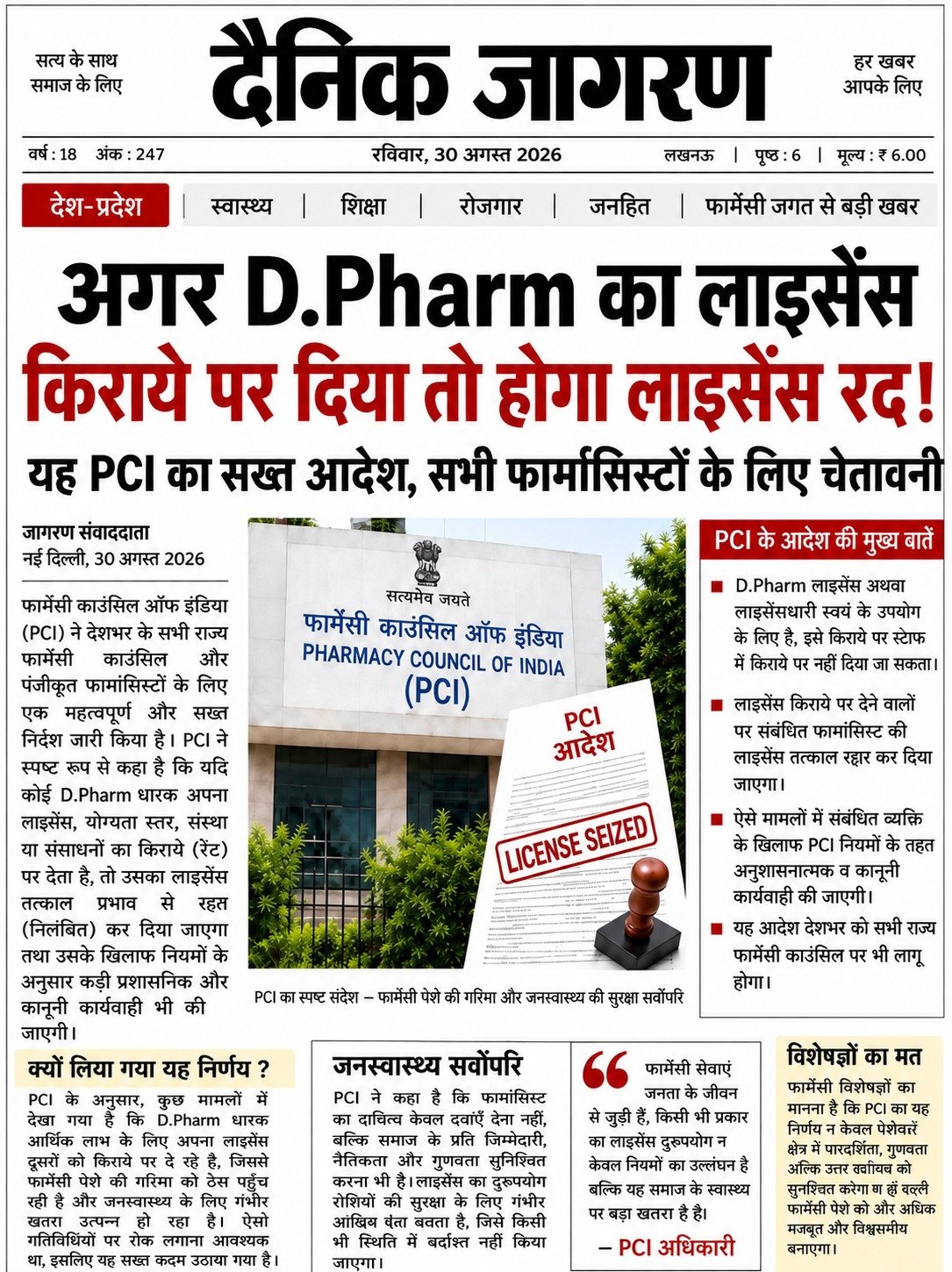
The newspaper clipping shared for this topic carries a strong headline about cancellation of a D.Pharm licence for giving it on rent.
However, the specific headline should not be treated as an independently verified PCI order unless the original official notification/order is available.
For an accurate legal or regulatory interpretation, pharmacists should rely on:
- Official PCI notifications
- Pharmacy Act, 1948
- State Pharmacy Council notifications
- Applicable Drug Control regulations
- Original government/authority orders
This approach helps prevent misinformation and unnecessary panic among pharmacy professionals.
FAQs About D.Pharm Licence on Rent
1. Can I give my D.Pharm licence on rent?
A pharmacist should not treat their pharmacist registration or professional credentials as a document that can simply be rented to another pharmacy. The registration is connected with professional responsibility and applicable regulatory requirements.
2. Is D.Pharm the same as a pharmacist licence?
No. D.Pharm is an educational qualification. Pharmacist registration is a separate regulatory process handled by the relevant State Pharmacy Council.
3. Who registers pharmacists in India?
Pharmacist registration is conducted by State Pharmacy Councils, not directly by PCI.
4. Can pharmacist registration be cancelled?
The Pharmacy Act contains provisions allowing removal of a registered pharmacist’s name from the register in specified circumstances, subject to the prescribed procedure.
5. Is D.Pharm still valid for pharmacist registration?
Yes. PCI lists D.Pharm as an approved qualification for pharmacist registration, subject to applicable statutory requirements.
6. Does every case of “licence on rent” lead to automatic cancellation?
No automatic conclusion should be made. The action depends on the facts, applicable laws/rules and the decision of the competent authority.
7. Where can I check official pharmacist registration rules?
You should check the official PCI website and the website/notification of your respective State Pharmacy Council.
8. Should pharmacists trust viral WhatsApp or Instagram posts about PCI rules?
No. Always verify the original notification, circular or order from the relevant official authority before taking action or sharing the information.
Recommended Products