


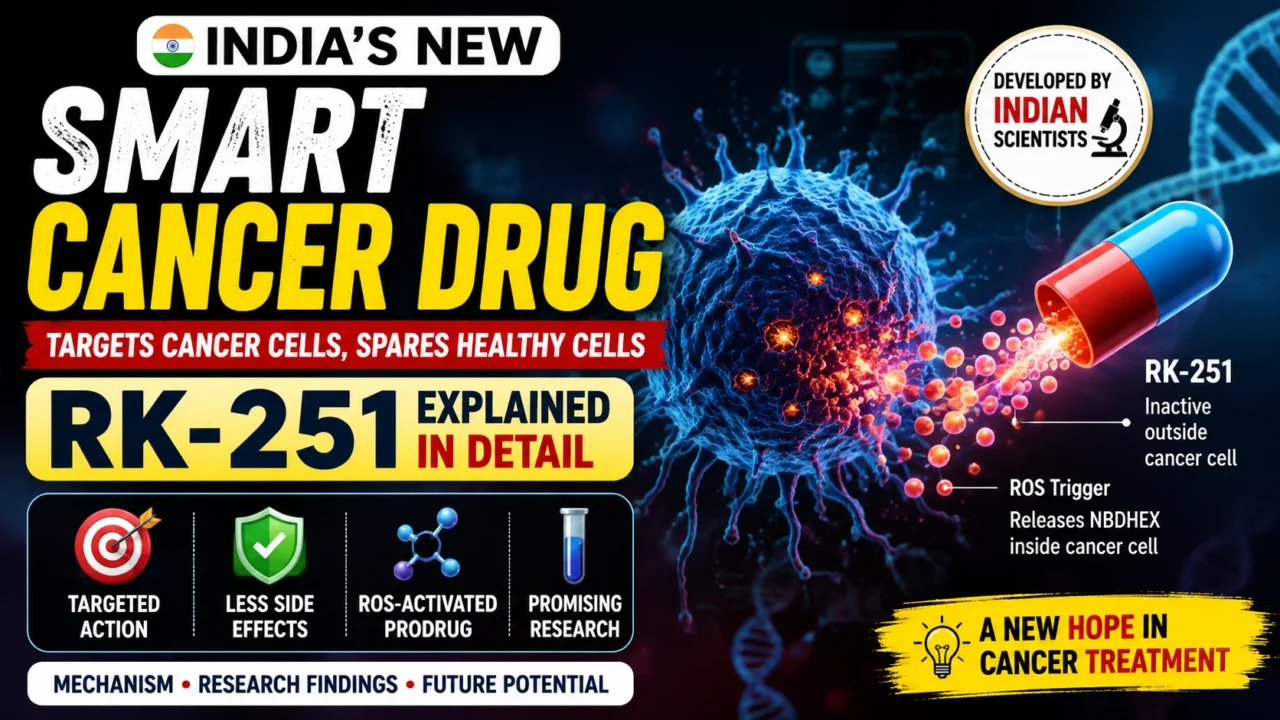

India has made an important contribution to cancer drug research with RK-251, an experimental smart cancer drug designed to become activated mainly in cancer cells. The ROS-responsive prodrug was developed through collaborative research involving scientists from the Institute of Advanced Study in Science and Technology (IASST) and IIT Guwahati.
Unlike conventional chemotherapy, which can affect both cancerous and healthy cells, RK-251 is designed around a more selective approach. It responds to reactive oxygen species (ROS) and releases the anticancer compound NBDHEX after activation.
However, RK-251 is still at the preclinical research stage and cannot currently be considered a replacement for chemotherapy.
Quick Summary
RK-251 is an experimental ROS-responsive cancer prodrug developed by Indian researchers. It is designed to activate in ROS-rich cancer cells and release NBDHEX, a GSTP1 inhibitor. Preclinical studies showed activity against triple-negative breast cancer cells, but human clinical trials are still required to determine its safety and effectiveness.

What Is RK-251?
RK-251 is a reactive oxygen species (ROS)-responsive fluorogenic prodrug of NBDHEX.
The drug has been designed to remain relatively inactive until it encounters conditions that can trigger its activation. Cancer cells can have elevated ROS levels, providing a potential biochemical trigger for selective drug activation.
The research was led by Dr. Asis Bala and Dr. Krishna P. Bhabak, with the work involving researchers from IASST and IIT Guwahati. The study was published in the Journal of Medicinal Chemistry in 2026.
RK-251 at a Glance
| Feature | Details |
|---|---|
| Drug candidate | RK-251 |
| Type | ROS-responsive fluorogenic prodrug |
| Active anticancer compound | NBDHEX |
| Main biological target | GSTP1 |
| Cancer model highlighted | Triple-negative breast cancer |
| Research stage | Preclinical |
| Key trigger | Reactive oxygen species (ROS) |
| Research institutions | IASST and IIT Guwahati |
| Published in | Journal of Medicinal Chemistry |
| Human clinical trials | Not yet established |
How Does RK-251 Work?
The key idea behind RK-251 is activatable drug delivery.
Step 1: RK-251 enters the biological system
RK-251 is designed as a prodrug rather than delivering its active anticancer component immediately.
Step 2: It encounters reactive oxygen species
Many cancer cells have altered redox biology and can contain elevated levels of reactive oxygen species (ROS).
RK-251 incorporates a ROS-responsive unit that can respond to this environment.
Step 3: ROS activates the prodrug
When the appropriate ROS-mediated reaction occurs, RK-251 undergoes activation and releases NBDHEX.
Step 4: NBDHEX acts on GSTP1
NBDHEX is an inhibitor of glutathione S-transferase pi (GSTP1), a protein associated with cellular detoxification and cancer biology.
The research showed that ROS-mediated activation of RK-251 produced NBDHEX release along with a near-infrared fluorescence response.
Simple Mechanism
RK-251 → ROS trigger → Prodrug activation → NBDHEX release → GSTP1 inhibition → Anticancer activity

Why Is This Approach Different From Conventional Chemotherapy?
Conventional chemotherapy can affect rapidly dividing cancer cells but may also affect healthy tissues, contributing to treatment-related toxicity.
RK-251 follows a different strategy:
| Conventional approach | RK-251 approach |
|---|---|
| Active drug is administered | Active drug is generated from a prodrug |
| Can affect healthy and cancer cells | Designed for activation in a specific cellular environment |
| Limited selectivity can contribute to toxicity | Aims for more selective drug activation |
| Systemic exposure to active drug | Attempts to control when the active compound is released |
This does not mean RK-251 has already been proven safer or better than chemotherapy. Those questions require further studies and eventually human clinical trials.
RK-251 and Triple-Negative Breast Cancer
One of the important findings from the research was RK-251’s activity against MDA-MB-231 triple-negative breast cancer cells.
The study reported potent anticancer activity against these cancer cells compared with nonmalignant cells. The researchers also observed modulation of cancer-related marker genes.
Triple-negative breast cancer is an aggressive breast cancer subtype that lacks three commonly targeted receptors:
- Estrogen receptor (ER)
- Progesterone receptor (PR)
- HER2
Because of its biological characteristics and limited targeted treatment options compared with some other breast cancer subtypes, new treatment strategies continue to be investigated.
What Did the Zebrafish Study Show?
The researchers also evaluated RK-251 in developing zebrafish embryos (Danio rerio).
The study used the fluorescence response to investigate ROS-mediated activation. The researchers reported no noticeable abnormalities or acute toxicities in the zebrafish model under the tested experimental conditions.
However, results from zebrafish experiments cannot be directly interpreted as proof of safety in humans.
Further mammalian studies and clinical research would be needed before conclusions about human safety can be made.
Can RK-251 Replace Chemotherapy?
No—not at this stage.
RK-251 should currently be described as an experimental cancer drug candidate, not an approved replacement for chemotherapy.
The research has so far demonstrated promising findings in preclinical models. Human clinical trials are needed to determine:
- Safety in humans
- Effective dosage
- Pharmacokinetics
- Side effects
- Therapeutic effectiveness
- Long-term safety
- Appropriate cancer indications
Therefore, the statement “RK-251 will replace chemotherapy” is premature.
A more accurate statement is:
RK-251 is a promising experimental approach that could contribute to more selective cancer treatment in the future.
What Is a Prodrug?
A prodrug is a compound that is designed to undergo conversion or activation in the body to produce its pharmacologically active form.
In the case of RK-251, researchers designed the molecule so that ROS-mediated activation can lead to the release of the active anticancer compound NBDHEX.
This strategy is sometimes called activatable drug delivery because the therapeutic component is designed to become active in response to a specific biological condition.
Why Is ROS Important in Cancer?
Reactive oxygen species (ROS) are chemically reactive molecules involved in normal cellular processes.
Cancer cells can experience increased oxidative stress because of their altered metabolism, rapid proliferation and other changes in cellular physiology.
This difference provides researchers with an opportunity to design ROS-responsive therapeutic systems.
RK-251 uses this concept by incorporating a ROS-responsive activation mechanism.
Who Developed RK-251?
The research involved scientists from Indian institutions including:
- Institute of Advanced Study in Science and Technology (IASST)
- Indian Institute of Technology Guwahati (IIT Guwahati)
The research was led by Asis Bala and Krishna P. Bhabak, with Rahul Kesarwani, Nikita Pal and Dorothy Das among the authors of the study.
Where Was the RK-251 Research Published?
The study was published in the Journal of Medicinal Chemistry, an ACS publication.
Research Paper
Title: Rational Development of Activatable Prodrugs of the GSTP1 Inhibitor NBDHEX: Turn-On NIR Fluorogenic Drug Delivery with Selective Anticancer Activity
Journal: Journal of Medicinal Chemistry
Year: 2026
DOI: 10.1021/acs.jmedchem.6c01286
Key Findings of the RK-251 Study
| Research finding | What it means |
|---|---|
| ROS-responsive activation | The drug is designed to respond to ROS |
| NBDHEX release | Activation releases the anticancer compound |
| GSTP1 inhibition | NBDHEX inhibits GSTP1 |
| Activity against MDA-MB-231 cells | Demonstrated anticancer activity in a TNBC cell model |
| Fluorescence activation | Provides a way to visualize activation |
| Zebrafish testing | No noticeable abnormalities or acute toxicities were reported under tested conditions |
| Current stage | Preclinical |
Why Is RK-251 Important for Pharmacy Students?
RK-251 is an interesting example of modern drug discovery and targeted drug delivery.
Pharmacy and pharmaceutical science students can connect this research with important concepts such as:
- Prodrug design
- Targeted drug delivery
- Cancer pharmacology
- Medicinal chemistry
- GSTP1 inhibition
- Reactive oxygen species
- Fluorogenic probes
- Drug discovery
- Preclinical evaluation
- Translational research
For B.Pharm, M.Pharm, GPAT and NIPER aspirants, RK-251 can also be useful as a current example of how medicinal chemistry and pharmaceutical research are being used to develop more selective therapies.
Current Status of RK-251
RK-251 is currently an experimental/preclinical drug candidate.
It has not been established as an approved cancer treatment for patients. The available research demonstrates promising laboratory and preclinical findings, but considerably more research is required before determining whether this strategy can be translated into human treatment.
Important Point
Preclinical success ≠ human clinical success.
This distinction is important when interpreting new drug-development research.
FAQs About RK-251
1. What is RK-251?
RK-251 is an experimental ROS-responsive fluorogenic prodrug designed to release the anticancer compound NBDHEX after activation.
2. Who developed RK-251?
The research involved scientists from IASST and IIT Guwahati, led by Asis Bala and Krishna P. Bhabak.
3. How does RK-251 work?
RK-251 is designed to respond to reactive oxygen species. ROS-mediated activation can release NBDHEX, which inhibits GSTP1 and produces anticancer activity.
4. Which cancer has RK-251 been tested against?
The study reported activity against MDA-MB-231 triple-negative breast cancer cells in preclinical experiments.
5. Can RK-251 replace chemotherapy?
Not currently. RK-251 remains a preclinical research candidate, and human clinical trials are required before its clinical effectiveness can be determined.
6. Is RK-251 approved for cancer treatment?
No approved human treatment status was established in the research discussed here.
7. What is NBDHEX?
NBDHEX is a GSTP1 inhibitor with anticancer activity. RK-251 was designed as a prodrug that can release NBDHEX following ROS-mediated activation.
8. Why is RK-251 called a “smart” cancer drug?
It is described as “smart” because its design attempts to make drug activation responsive to a biological condition—elevated ROS—rather than simply releasing the active compound indiscriminately.
Conclusion
RK-251 represents a promising direction in cancer drug research from India. Its ROS-responsive design aims to activate the drug in a cancer-associated chemical environment and release NBDHEX, potentially improving selectivity.
Preclinical findings against triple-negative breast cancer cells and studies in zebrafish provide a basis for further investigation. However, RK-251 has not yet been proven to replace chemotherapy, and its safety and effectiveness in humans remain to be established.
The research highlights an important direction in modern pharmaceutical science: developing activatable prodrugs that can deliver anticancer activity more selectively.
Recommended Products