


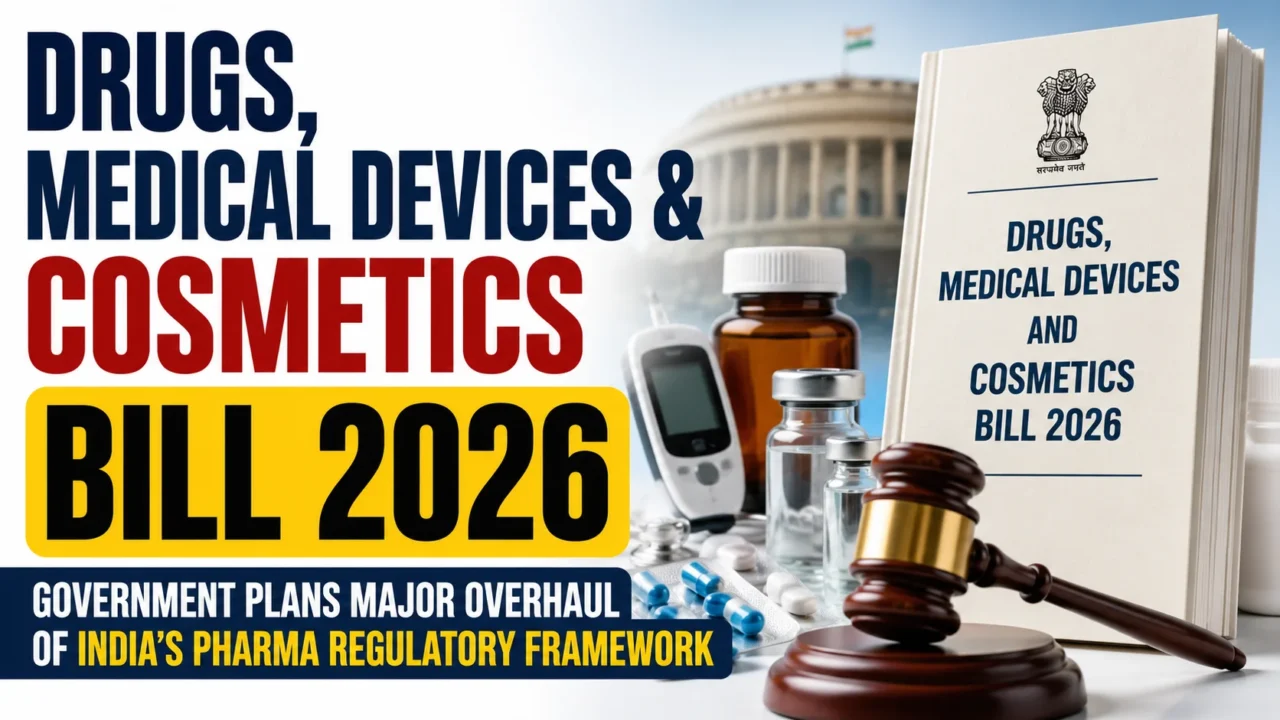

The Drugs, Medical Devices and Cosmetics Bill 2026 could bring a major change to India’s pharmaceutical and healthcare regulatory framework. The Ministry of Health has prepared a draft Bill that proposes to repeal and replace the Drugs and Cosmetics Act, 1940, according to an Economic Times report published on August 7, 2026. The draft has reportedly been circulated among other ministries and departments for feedback.
The proposed legislation seeks to create a modern regulatory framework for drugs, medical devices and cosmetics, with provisions covering regulatory powers, approvals, clinical trials, product recalls, licensing and enforcement.

Important: The Drugs, Medical Devices and Cosmetics Bill 2026 is currently a draft proposal, not a final law. Its provisions may change during the consultation and legislative process.
Quick Summary
The Drugs, Medical Devices and Cosmetics Bill 2026 proposes to replace the Drugs and Cosmetics Act, 1940 with a broader regulatory framework for drugs, medical devices and cosmetics. Key proposals include stronger DCGI powers, faster approvals, immediate product recalls, stricter action against serious drug offences and a dedicated Medical Devices Technical Advisory Board.
What Is the Drugs, Medical Devices and Cosmetics Bill 2026?
The Drugs, Medical Devices and Cosmetics Bill 2026 is a proposed legislation intended to modernize India’s regulatory framework for pharmaceutical and healthcare products.
At present, the Drugs and Cosmetics Act, 1940 remains a key central law governing the import, manufacture, distribution and sale of drugs and cosmetics. CDSCO continues to list the Act on its official Acts and Rules portal.
The proposed Bill would seek to replace this older framework with a new law covering:
- Drugs
- Medical devices
- Cosmetics
- Clinical trials
- Drug approvals
- Product safety
- Licensing
- Product recalls
- Regulatory enforcement
- Central and state regulatory coordination
Why Is India Proposing a New Drugs Law?
The pharmaceutical and healthcare sectors have changed significantly since the Drugs and Cosmetics Act, 1940 was enacted.
Modern drug development, medical devices, clinical research and new healthcare technologies require a regulatory framework that can address newer products and regulatory challenges.
The proposed Bill therefore aims to create a more comprehensive framework for:
- Modern drugs and therapies
- Medical devices
- Clinical trials
- Drug and device approvals
- Product quality and safety
- Recalls
- Regulatory enforcement
- Coordination between central and state authorities
CDSCO currently performs important functions including new-drug approvals, clinical-trial regulation, drug standards and coordination with State Drug Control Organisations under the existing framework.
Drugs, Medical Devices and Cosmetics Bill 2026: Key Proposals
1. Repeal and Replacement of the Drugs and Cosmetics Act, 1940
One of the most important proposals is to repeal and replace the Drugs and Cosmetics Act, 1940.
The proposed Bill would create a consolidated regulatory framework covering drugs, medical devices and cosmetics.
If enacted, this would represent a major change in India’s pharmaceutical regulatory system.
2. Greater Powers for the DCGI
The draft proposes stronger powers for the Drugs Controller General of India (DCGI).
According to the reported draft, the Drugs and Medical Devices Controller General could issue binding directions to state drug regulators.
If a state regulator fails to take necessary action, the central regulator could potentially intervene directly.
The proposal also provides for states to appoint State Drugs and Medical Devices Controllers for local enforcement.
Why Is This Important?
Greater central coordination could potentially help improve:
- Regulatory uniformity
- Enforcement
- Inter-state coordination
- Product safety oversight
- Implementation of regulatory decisions
3. Dedicated Chapter for Medical Devices
The proposed Bill includes a dedicated chapter on medical devices.
Under the existing framework, certain medical devices are notified and regulated as drugs. The new proposal would provide a more specific statutory framework for medical-device regulation.
This could be significant for India’s growing medical-device industry and for professionals working in:
- Medical-device manufacturing
- Regulatory affairs
- Quality assurance
- Clinical evaluation
- Compliance
- Medical-device research
4. Stricter Action Against Substandard and Fake Drugs
The draft proposes stricter treatment of serious offences involving:
- Not-of-standard-quality drugs
- Adulterated drugs
- Spurious drugs
- Counterfeit drugs
- Misbranded drugs
For serious offences involving the manufacture or sale of such products, the draft proposes more restrictive bail conditions.
According to the reported proposal, the public prosecutor would have an opportunity to oppose bail, and the court would need to be satisfied about specified conditions before granting bail. High Courts would retain their special powers regarding bail.
Why Is This Important?
The proposal could strengthen enforcement against products that pose serious risks to medicine quality and patient safety.
5. Faster Drug and Medical Device Approvals
The draft proposes giving the national regulator greater authority to fast-track approvals for new drugs and medical devices.
The regulator could potentially authorize faster access to new products and may waive certain clinical-trial data requirements where public-health considerations require rapid action.
Such provisions could become particularly relevant during:
- Public-health emergencies
- Urgent medical situations
- Situations requiring rapid access to new technologies
However, the exact conditions and safeguards would depend on the final legislation and rules.
6. Immediate Product Recalls
Another important proposal is the power to order products to be withdrawn from the market immediately when they are found to be unsafe or non-compliant.
The reported draft also proposes powers relating to:
- Granting licences
- Suspending licences
- Cancelling licences
- Ordering destruction of products that fail to meet prescribed standards
This could strengthen India’s regulatory response to unsafe medicines, medical devices and cosmetics.
7. Medical Devices Technical Advisory Board (MDTAB)
The draft proposes a dedicated Medical Devices Technical Advisory Board (MDTAB).
It would function alongside the existing Drugs Technical Advisory Board (DTAB).
The proposed MDTAB would include representatives from:
- Government
- Academia
- Industry
According to the reported draft, both DTAB and MDTAB would meet at least once every six months.
DTAB vs Proposed MDTAB
| Board | Main Area |
|---|---|
| DTAB | Drugs and related technical regulatory matters |
| MDTAB | Medical devices and related technical regulatory matters |
8. Central and State Advisory Committees
The draft also proposes additional advisory mechanisms to improve regulatory coordination.
A Central Advisory Committee would provide technical advice to DTAB and MDTAB on matters related to:
- Drugs
- Cosmetics
- Medical devices
States would also constitute similar advisory committees.
The proposed framework further includes a Drugs, Medical Devices and Cosmetics Consultative Committee to advise the central and state governments and the technical advisory boards on matters intended to promote regulatory uniformity.

Drugs and Cosmetics Act 1940 vs Proposed 2026 Bill
| Existing Framework | Proposed 2026 Framework |
|---|---|
| Drugs and Cosmetics Act, 1940 | Drugs, Medical Devices and Cosmetics Bill, 2026 |
| Existing regulation of drugs and cosmetics | Proposed broader framework for drugs, devices and cosmetics |
| Certain medical devices regulated through existing notifications | Dedicated medical-device chapter proposed |
| Existing central-state regulatory structure | Stronger central-state coordination proposed |
| Existing approval framework | Fast-track approvals proposed |
| Existing enforcement mechanisms | Stronger enforcement proposed for serious offences |
| Existing product withdrawal mechanisms | Immediate recall/withdrawal powers proposed |
| DTAB | DTAB + proposed MDTAB |
| Existing advisory mechanisms | Additional central/state advisory committees proposed |
Note: The proposed column describes provisions reported from the draft Bill and should not be interpreted as final law.
What Could the Bill Mean for the Pharmaceutical Industry?
If the proposed legislation is enacted, it could affect several areas of the pharmaceutical industry.
Impact on Pharmaceutical Companies
Companies could experience changes in:
- Product licensing
- Regulatory compliance
- Manufacturing oversight
- Product quality requirements
- Safety monitoring
- Product recalls
- Regulatory enforcement
At the same time, faster approval mechanisms could potentially support quicker access to innovative drugs and technologies.
Impact on Medical Device Manufacturers
A dedicated statutory framework for medical devices could provide greater clarity regarding:
- Device regulation
- Licensing
- Safety
- Quality
- Regulatory oversight
- Compliance requirements
The exact impact will depend on the final Bill and subsequent rules.
Impact on Patients
Stronger enforcement against substandard, adulterated, spurious and counterfeit products could potentially strengthen patient safety.
Faster approval mechanisms could also support quicker access to certain new medicines or medical devices where public-health requirements justify accelerated action.
Impact on Pharmacists and Pharmacy Students
The proposed Bill is particularly relevant for pharmacy students and professionals because pharmaceutical regulation is closely connected with:
- Pharmaceutical Jurisprudence
- Drugs and Cosmetics Law
- Regulatory Affairs
- Quality Assurance
- Drug Manufacturing
- Drug Inspection
- Medical Devices
- Clinical Research
- Pharmaceutical Industry Compliance
For students preparing for GPAT, Drug Inspector, Pharmacist and other pharmacy competitive examinations, this development is worth following.
Exam Preparation Tip
Students should remember the distinction:
Current framework: Drugs and Cosmetics Act, 1940
Proposed framework: Drugs, Medical Devices and Cosmetics Bill, 2026
The proposed Bill should not be treated as enacted law unless and until it completes the required legislative process.
Why Should Pharmacy Candidates Follow This Update?
For pharmacy aspirants, this development can be important for both current affairs and pharmaceutical jurisprudence.
The proposed changes directly relate to topics such as:
- Drug regulatory authorities
- DCGI and CDSCO
- Drug licensing
- Drug quality standards
- Medical-device regulation
- Clinical trials
- Drug recalls
- Regulatory offences
- Central and State drug control administration
This makes the topic relevant for Drug Inspector, Pharmacist, GPAT and other competitive pharmacy examinations.
Is the Drugs, Medical Devices and Cosmetics Bill 2026 Final?
No. The Bill is currently a draft proposal.
The Health Ministry has prepared the draft and circulated it to other ministries and departments for feedback, according to the August 7, 2026 report. Therefore, provisions may change before the government takes further legislative action.
Meanwhile, CDSCO continues to list the Drugs and Cosmetics Act, 1940 under its current Acts and Rules framework.
Current Status at a Glance
| Question | Status |
|---|---|
| Is the Bill a draft? | Yes |
| Has it been circulated for feedback? | Yes, according to the reported draft status |
| Does it propose replacing the 1940 Act? | Yes |
| Is the 2026 Bill currently final law? | No |
| Can the provisions change? | Yes |
Important Points to Remember
- The Drugs, Medical Devices and Cosmetics Bill 2026 is a proposed new regulatory framework.
- It seeks to replace the Drugs and Cosmetics Act, 1940.
- The draft proposes stronger powers for the DCGI.
- A dedicated chapter for medical devices is proposed.
- A Medical Devices Technical Advisory Board (MDTAB) is proposed.
- Faster approvals for certain drugs and medical devices are proposed.
- Immediate product withdrawal/recall powers are proposed.
- Stricter bail provisions are proposed for certain serious drug offences.
- The draft is not yet final legislation.
- The existing Drugs and Cosmetics Act, 1940 remains part of the current CDSCO framework.
Frequently Asked Questions
1. What is the Drugs, Medical Devices and Cosmetics Bill 2026?
It is a proposed Indian legislation intended to create a modern regulatory framework for drugs, medical devices and cosmetics and replace the Drugs and Cosmetics Act, 1940.
2. Will the Drugs and Cosmetics Act, 1940 be replaced?
The draft Bill proposes to repeal and replace the Drugs and Cosmetics Act, 1940. However, the 2026 Bill is still a draft and is not yet final law.
3. What are the major proposals in the 2026 Bill?
Major reported proposals include stronger DCGI powers, a dedicated medical-device chapter, faster approvals, immediate recalls, stricter action for serious drug offences and new advisory bodies for medical devices.
4. What is the proposed Medical Devices Technical Advisory Board?
The MDTAB is a proposed technical advisory body for medical devices. The draft reportedly provides for representation from government, academia and industry.
5. Will the DCGI get more powers under the proposed Bill?
Yes. The draft proposes that the Drugs and Medical Devices Controller General could issue binding directions to state drug regulators and intervene directly if a state fails to take necessary action.
6. Does the Bill propose faster drug approvals?
Yes. The draft proposes powers for the national regulator to fast-track certain new drug and medical-device approvals and potentially waive certain trial-data requirements where public health requires it.
7. Is the Drugs, Medical Devices and Cosmetics Bill 2026 applicable now?
No. It is currently a draft proposal. The provisions may change before any final legislation is enacted. The existing Drugs and Cosmetics Act, 1940 remains part of the current CDSCO regulatory framework.
8. Why is this Bill important for pharmacy students?
The proposed legislation is relevant to Pharmaceutical Jurisprudence, Drug Inspector exams, regulatory affairs, drug licensing, CDSCO, DCGI, medical-device regulation and drug-quality enforcement. Therefore, pharmacy students and competitive-exam aspirants should follow further developments.
Important Links
| Resource | Link |
|---|---|
| CDSCO – Acts & Rules | CDSCO Acts & Rules |
| Drugs and Cosmetics Act, 1940 – CDSCO | Drugs and Cosmetics Act, 1940 |
| Official CDSCO Website | Central Drugs Standard Control Organisation |
| Reported Bill Update | Economic Times report on the proposed Bill |
Note: An official government PDF/draft of the Drugs, Medical Devices and Cosmetics Bill 2026 was not located on the CDSCO sources checked for this article. Therefore, no unverified draft-PDF link has been added.
Conclusion
The Drugs, Medical Devices and Cosmetics Bill 2026 could represent a major overhaul of India’s pharmaceutical and healthcare regulatory framework. The draft proposes to replace the Drugs and Cosmetics Act, 1940 with a broader system covering drugs, medical devices and cosmetics.
Among the most significant proposals are greater DCGI powers, a dedicated medical-device framework, faster approvals, immediate product recalls, stricter action against serious drug offences and new technical advisory bodies.
For pharmacists, pharmacy students, pharmaceutical companies, regulatory professionals and medical-device manufacturers, the development is important to monitor. However, the Bill remains at the draft stage, so the final provisions may differ from those currently reported.
For the latest updates, candidates should verify future developments through official government and CDSCO sources before treating any proposed provision as enacted law.
Recommended Products