


Quick Summary
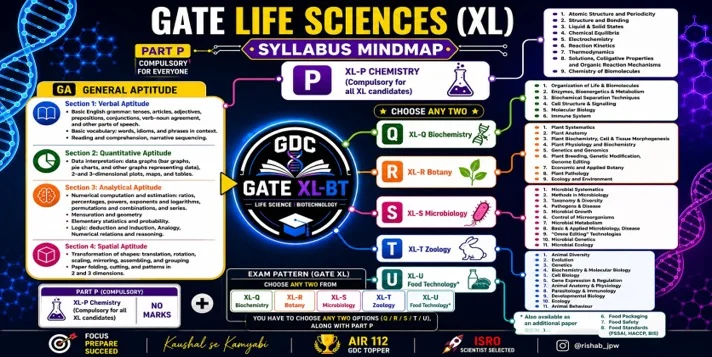
The GATE XL Biotechnology 2027 Syllabus consists of three major sections: General Aptitude (GA), Chemistry (XL0 – Compulsory), and one optional subject from Biochemistry, Botany, Microbiology, Zoology, or Food Technology. Understanding the syllabus helps candidates prepare strategically and focus on high-weightage topics.

Overview
The Graduate Aptitude Test in Engineering (GATE) XL paper is designed for students from Life Sciences and Biotechnology backgrounds. Every candidate must attempt the General Aptitude section, the Chemistry (XL0) section, and one optional subject based on their academic background.
This syllabus guide by GDC Classes provides a concise overview of every section to help you plan your preparation efficiently.
GATE XL Biotechnology 2027 Exam Pattern
| Section | Details |
| Exam Mode | Computer Based Test (CBT) |
| Total Marks | 100 |
| General Aptitude | Compulsory |
| Chemistry (XL0) | Compulsory |
| Optional Subject | Choose One (XL1–XL5) |
| Duration | 3 Hours |
Subjects Included in GATE XL Biotechnology
| Code | Subject |
| XL0 | Chemistry (Compulsory) |
| XL1 | Biochemistry |
| XL2 | Botany |
| XL3 | Microbiology |
| XL4 | Zoology |
| XL5 | Food Technology |
| GA | General Aptitude |
GATE XL Chemistry (XL0) Syllabus
Chemistry is compulsory for all XL candidates and forms the foundation of the examination.
Physical Chemistry
Prepare the following topics:
- Atomic Structure
- Periodic Table & Periodicity
- Quantum Theory
- Chemical Equilibrium
- Ionic Equilibrium
- Thermodynamics
- Electrochemistry
- Reaction Kinetics
Inorganic Chemistry
Important chapters include:
- Chemical Bonding
- Hybridization
- Molecular Geometry (VSEPR Theory)
- Coordination Compounds
- Crystal Field Theory
- s, p & d Block Elements
- Bioinorganic Chemistry
- HSAB Principle
Organic Chemistry
Focus on:
- Reaction Mechanisms
- SN1 & SN2
- E1 & E2
- Aromatic Compounds
- Hydroboration
- Grignard Reagents
- Stereochemistry
- Functional Group Identification
Biomolecules & Analytical Chemistry
Important topics include:
- Amino Acids
- Proteins
- Carbohydrates
- Lipids
- DNA & RNA
- Chromatography
- Spectroscopy
- Biomolecule Purification
GATE XL1 Biochemistry Syllabus
Biochemistry focuses on the chemistry of living organisms and biological processes.
Structure & Function of Biomolecules
Topics include:
- Carbohydrates
- Proteins
- Lipids
- Nucleic Acids
- Protein Folding
- Hemoglobin & Myoglobin
Enzymes & Metabolism
Study the following:
- Enzyme Kinetics
- Enzyme Inhibition
- Vitamins
- Coenzymes
- ATP Generation
- Hormonal Regulation
Metabolic Pathways
Important pathways:
- Glycolysis
- TCA Cycle
- Pentose Phosphate Pathway
- Oxidative Phosphorylation
- Gluconeogenesis
- Fatty Acid Metabolism
- Photosynthesis
- Calvin Cycle
Cell Biology & Molecular Biology
Topics include:
- Cell Structure
- Cell Organelles
- Membrane Transport
- DNA Replication
- Transcription
- Translation
- Gene Regulation
- DNA Repair
Analytical Techniques
Prepare:
- PCR
- ELISA
- Flow Cytometry
- Electrophoresis
- Chromatography
- DNA Sequencing
- Spectroscopy
- Antigen-Antibody Techniques

GATE XL2 Botany Syllabus
Botany focuses on plant biology, genetics, physiology, breeding, ecology, and biotechnology. Candidates with a Life Sciences or Biotechnology background should prepare these topics thoroughly.
Plant Systematics
- Botanical Nomenclature
- Plant Classification
- APG Classification System
- Major Plant Families
- Molecular Taxonomy
- DNA Barcoding
- Indian Herbaria
Plant Anatomy & Development
Study the following topics:
- Root, Stem & Leaf Anatomy
- Primary & Secondary Growth
- Xylem and Phloem
- Embryogenesis
- Floral Development
- Photoperiodism
- Vernalization
- Plant Hormones
Plant Physiology & Biochemistry
Important topics include:
- Water Relations
- Mineral Nutrition
- Photosynthesis
- Photorespiration
- Respiration
- Nitrogen Metabolism
- Plant Hormones
- Secondary Metabolites
- Senescence
Genetics & Plant Biotechnology
Prepare:
- Mendelian Genetics
- Gene Mapping
- Epigenetics
- Plant Tissue Culture
- Molecular Markers
- Marker-Assisted Selection
- CRISPR/Cas9
- Transgenic Plants
Plant Pathology & Ecology
Focus on:
- Plant Diseases
- Plant-Microbe Interaction
- Disease Resistance
- Biodiversity
- Ecosystems
- Climate Change
- Conservation Biology
GATE XL3 Microbiology Syllabus
Microbiology deals with microorganisms, microbial genetics, metabolism, immunology, and biotechnology.
Fundamentals of Microbiology
Topics include:
- History of Microbiology
- Microbial Classification
- Bacteria
- Archaea
- Viruses
- Fungi
- Protozoa
Microbial Physiology
Prepare:
- Cell Structure
- Cell Membrane
- Cell Wall
- Bacterial Growth
- Growth Curve
- Biofilms
- Quorum Sensing
Microbial Metabolism
Important chapters:
- Glycolysis
- TCA Cycle
- Pentose Phosphate Pathway
- Fermentation
- Photosynthesis
- Chemolithotrophy
- Oxidative Phosphorylation
Microbial Genetics & Immunology
Study:
- Mutation
- Transformation
- Conjugation
- Transduction
- Operon Model
- DNA Repair
- CRISPR-Cas
- Vaccines
- Antigen-Antibody Interaction
Applied Microbiology
Topics include:
- Antibiotics
- Antimicrobial Resistance
- Food Microbiology
- Environmental Microbiology
- Bioremediation
- Metagenomics
GATE XL4 Zoology Syllabus
The Zoology section covers animal biology, evolution, physiology, genetics, ecology, and developmental biology.
Animal Biology
Important topics:
- Animal Classification
- Evolution
- Speciation
- Adaptation
Genetics & Molecular Biology
Study:
- Mendelian Genetics
- Linkage
- Recombination
- Population Genetics
- DNA Replication
- Transcription
- Translation
Cell Biology
Prepare:
- Cell Organelles
- Cell Cycle
- Cell Division
- Chromosomes
- Cytoskeleton
Animal Physiology
Focus on:
- Digestive System
- Circulatory System
- Respiratory System
- Nervous System
- Endocrine System
- Reproductive System
- Excretory System
Development & Ecology
Topics include:
- Embryonic Development
- Stem Cells
- Immunology
- Ecology
- Biodiversity
- Animal Behaviour
GATE XL5 Food Technology Syllabus
Food Technology combines food science, microbiology, engineering, processing, and food safety.
Food Chemistry
Study:
- Carbohydrates
- Proteins
- Lipids
- Vitamins
- Minerals
- Food Enzymes
- Food Additives
Food Microbiology
Important topics:
- Food Spoilage
- Foodborne Pathogens
- Fermented Foods
- Probiotics
- Food Preservation
Food Processing
Prepare:
- Thermal Processing
- Refrigeration
- Freezing
- Drying
- Packaging
- Dairy Technology
- Fruit & Vegetable Processing
- Meat Processing
Food Engineering
Topics include:
- Heat Transfer
- Mass Transfer
- Fluid Flow
- Mixing
- Evaporation
- Spray Drying
- Freeze Drying
Food Safety
Focus on:
- HACCP
- FSSAI
- BIS
- Codex Alimentarius
- Food Quality Standards
- Food Safety Management Systems (FSMS)
General Aptitude (GA) Syllabus
The General Aptitude section is common to all GATE papers and carries significant weightage.
Verbal Ability
- English Grammar
- Vocabulary
- Reading Comprehension
- Sentence Completion
Quantitative Aptitude
- Percentage
- Ratio & Proportion
- Probability
- Statistics
- Geometry
- Data Interpretation
Logical & Analytical Reasoning
Prepare:
- Coding-Decoding
- Series
- Analogy
- Logical Deduction
- Numerical Reasoning
Spatial Aptitude
Study:
- Rotation
- Mirror Images
- Paper Folding
- Pattern Recognition
- 2D & 3D Visualization
Important Preparation Tips
| Preparation Strategy | Benefit |
| Complete Chemistry First | Builds strong fundamentals |
| Finish One Optional Subject | Maximizes scoring potential |
| Practice PYQs Daily | Understand exam trends |
| Attempt Weekly Mock Tests | Improve speed and accuracy |
| Revise Notes Regularly | Better retention |
Why Choose GDC Classes?
At GDC Classes, students receive:
- Live Interactive Classes
- Complete Topic-wise Notes
- Daily Practice Questions
- Previous Year Question Discussions
- Mock Tests
- Doubt Solving Sessions
- Revision Classes
- Exam-Oriented Preparation Strategy
Best Preparation Tips
- Complete Chemistry before starting your optional subject.
- Prepare short notes for every chapter.
- Solve Previous Year Questions regularly.
- Revise formulas and reaction mechanisms weekly.
Attempt full-length mock tests before the examFrequently Asked Questions (FAQs)
1. Is Chemistry compulsory in GATE XL?
Yes. Chemistry (XL0) is compulsory for every GATE XL candidate.
2. How many optional subjects can I choose?
You can select one optional subject from Biochemistry, Botany, Microbiology, Zoology, or Food Technology.
3. Which optional subject is best for Biotechnology students?
Most Biotechnology students choose Biochemistry (XL1), but the best choice depends on your academic background and strengths.
4. Is General Aptitude compulsory?
Yes. General Aptitude (GA) is compulsory in every GATE examination.
5. Are Previous Year Questions important?
Yes. Solving PYQs helps you understand the exam pattern, frequently asked topics, and difficulty level.
6. Where can I download the official syllabus?
You can download the latest syllabus from the official GATE website when the notification is released.
| Resource | Status |
| GATE Official Website | Check official notification |
| GATE XL 2027 Syllabus PDF | Available with official brochure |
| GDC Classes GATE XL Course | Available on GDC Classes |
Conclusion
The GATE XL Biotechnology 2027 Syllabus is comprehensive and covers Chemistry, General Aptitude, and one optional Life Sciences subject. A structured preparation plan, consistent revision, and regular practice with previous year questions are the keys to success. Begin your preparation early, follow the official syllabus, and focus on conceptual clarity to maximize your GATE score.
Recommended Products