


Meta Title: UPSC Drug Inspector 2026 Preparation Strategy | Complete Study Plan
Meta Description: Learn the best UPSC Drug Inspector 2026 preparation strategy with a complete study plan, subject-wise preparation tips, recommended books, revision techniques, mock test strategy, and expert guidance to crack the exam on your first attempt.

UPSC Drug Inspector 2026 Preparation Strategy: Complete Study Plan for First Attempt
The UPSC Drug Inspector Examination 2026 is expected to be one of the most competitive recruitment exams for pharmacy and pharmaceutical science graduates in India. A Drug Inspector plays a crucial role in ensuring the quality, safety, and efficacy of medicines available in the market. Since the competition is high, candidates need a well-planned preparation strategy to secure a good rank.
This guide provides a complete preparation roadmap, including subject-wise strategy, study timetable, recommended books, revision plan, mock test approach, and expert tips to help you crack the UPSC Drug Inspector Exam on your first attempt.
About the UPSC Drug Inspector Examination
The Drug Inspector recruitment process generally evaluates candidates on their knowledge of pharmaceutical sciences, drug regulations, analytical techniques, and general aptitude. A strong understanding of pharmacy fundamentals combined with regular practice is the key to success.
Before starting your preparation:
- Carefully read the official notification when it is released.
- Understand the eligibility criteria.
- Check the detailed syllabus.
- Know the exam pattern.
- Prepare a realistic study schedule.
Understand the Syllabus First
The biggest mistake many candidates make is starting preparation without understanding the syllabus.
Prepare a checklist covering:
- Pharmaceutics
- Pharmaceutical Chemistry
- Pharmacology
- Pharmacognosy
- Pharmaceutical Analysis
- Biochemistry
- Microbiology
- Hospital & Clinical Pharmacy
- Drug Store Management
- Pharmaceutical Jurisprudence
- Human Anatomy & Physiology
- Quality Assurance
- Biotechnology
- General Aptitude
- General English
- Current Affairs (if applicable)
Print the syllabus and keep it on your study table.
Subject-Wise Preparation Strategy
1. Pharmaceutics
Focus on:
- Dosage forms
- Tablets
- Capsules
- Parenterals
- Sterile products
- Industrial Pharmacy
- GMP
- Validation
- Packaging Technology
Practice formulation-based numerical questions.
2. Pharmaceutical Chemistry
Study:
- Medicinal Chemistry
- Organic Chemistry
- Inorganic Pharmacy
- Pharmaceutical Analysis
Give extra attention to:
- Drug structures
- Mechanism of action
- SAR
- Impurities
- Identification tests
3. Pharmacology
Important topics include:
- Autonomic Nervous System
- CNS
- Cardiovascular Drugs
- Endocrine Drugs
- Chemotherapy
- Antibiotics
- Toxicology
- Clinical Pharmacology
Prepare handwritten charts for drug classifications.
4. Pharmaceutical Analysis
Cover:
- UV Spectroscopy
- IR
- HPLC
- GC
- TLC
- Chromatography
- Validation
- Limit Tests
Solve previous analytical chemistry questions regularly.
5. Pharmaceutical Jurisprudence
This is one of the highest-scoring sections.
Focus on:
- Drugs and Cosmetics Act
- Drugs and Cosmetics Rules
- Pharmacy Act
- NDPS Act
- Medical Termination of Pregnancy Act
- Drug Licensing
- Schedule Labels
- Regulatory Authorities
Revise legal provisions multiple times.
6. Pharmacognosy
Study:
- Crude Drugs
- Plant Constituents
- Identification
- Herbal Medicines
- Tissue Culture
- Marine Pharmacognosy
Practice scientific names regularly.
7. Human Anatomy & Physiology
Revise:
- Cardiovascular System
- Respiratory System
- Nervous System
- Endocrine System
- Digestive System
- Renal System
Prepare diagrams for quick revision.
8. Microbiology
Important topics:
- Sterilization
- Disinfection
- Immunology
- Vaccines
- Culture Media
- Microbial Genetics
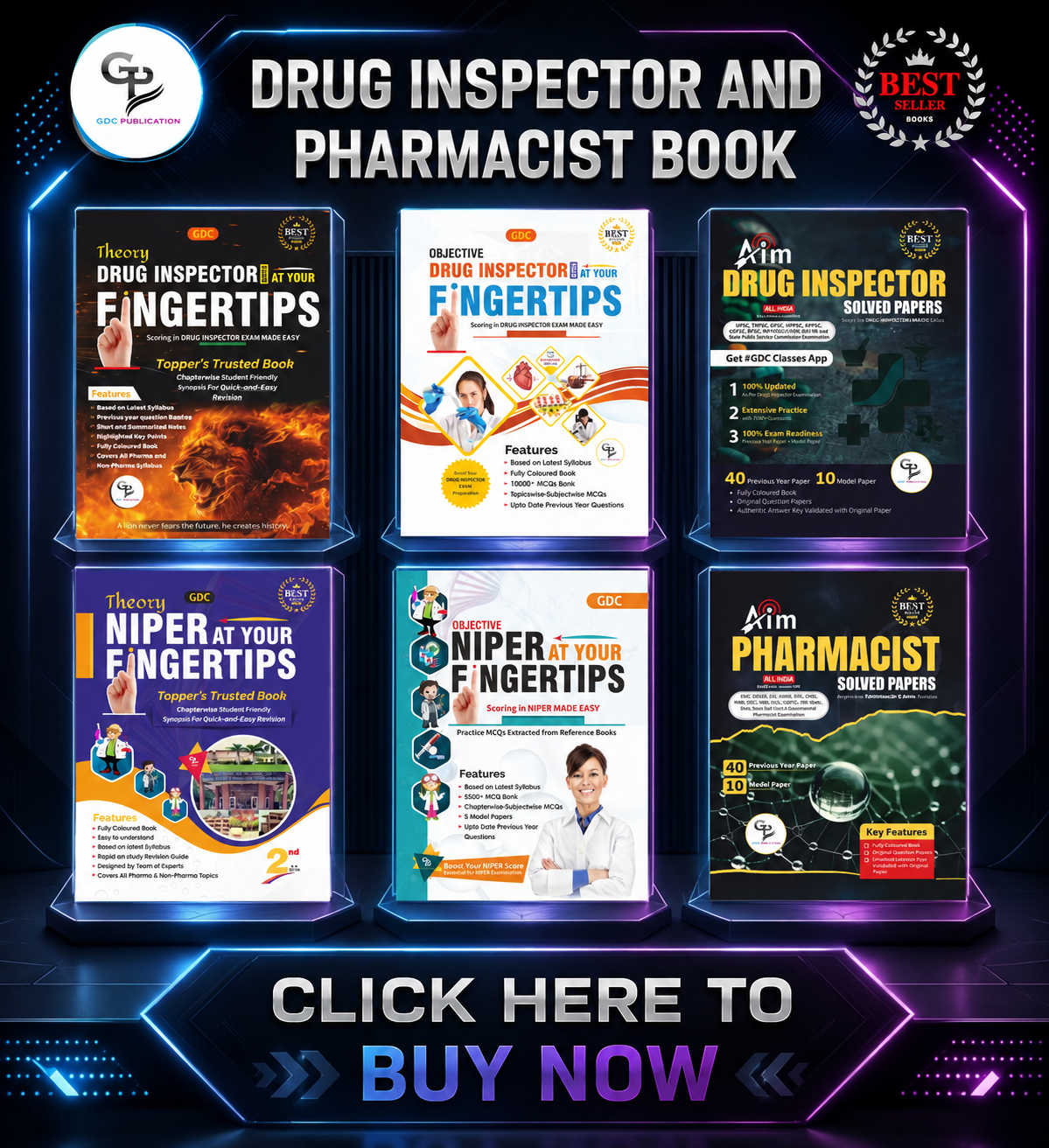
Best Books for UPSC Drug Inspector Preparation
Some commonly recommended resources include:
- Standard B.Pharm textbooks
- Pharmaceutical Jurisprudence reference books
- Pharmaceutical Analysis books
- Pharmacology by KD Tripathi
- Pharmaceutics by Lachman
- Organic Chemistry reference books
- Previous Year Drug Inspector Question Papers
Choose one reliable book for each subject and avoid collecting too many resources.
Daily Study Plan
A balanced daily schedule may look like this:
| Time | Activity |
|---|---|
| 6:00 AM – 7:00 AM | Revision |
| 7:00 AM – 9:00 AM | Core Subject 1 |
| 10:00 AM – 12:00 PM | Core Subject 2 |
| 2:00 PM – 4:00 PM | Practice MCQs |
| 5:00 PM – 6:00 PM | Short Notes |
| 7:00 PM – 9:00 PM | Mock Test / PYQs |
| 9:30 PM | Quick Revision |
Aim for 6–8 focused study hours daily, depending on your schedule.
Mock Test Strategy
Mock tests are essential for improving speed and accuracy.
- Start with topic-wise tests.
- Move to sectional tests.
- Attempt full-length mock tests regularly.
- Analyze every mistake.
- Maintain an error notebook for revision.
Previous Year Question Papers
Solving previous year papers helps you:
- Understand question trends.
- Identify important topics.
- Improve time management.
- Build confidence.
Practice under exam-like conditions.
Revision Strategy
Follow the 3-Revision Rule:
First Revision
Within 24 hours of studying a topic.
Second Revision
After one week.
Third Revision
Within one month.
This spaced revision method helps retain concepts for a longer period.
Last 60 Days Preparation Plan
Days 1–20
- Complete remaining subjects.
- Solve topic-wise MCQs.
Days 21–40
- Revise all major subjects.
- Attempt sectional mock tests.
Days 41–60
- Full-length mock tests.
- Revise short notes.
- Focus on weak areas.
- Avoid learning completely new topics.
Common Mistakes to Avoid
- Ignoring the official syllabus.
- Studying from too many books.
- Not solving previous year papers.
- Skipping revision.
- Taking too many mock tests without analysis.
- Poor time management.
- Neglecting Pharmaceutical Jurisprudence.
Expert Tips to Crack UPSC Drug Inspector 2026
- Build strong conceptual knowledge.
- Practice MCQs every day.
- Revise consistently.
- Make concise handwritten notes.
- Stay updated with important pharmaceutical developments.
- Focus on accuracy as well as speed.
- Take regular mock tests.
- Maintain discipline and consistency throughout your preparation.
Final Words
Cracking the UPSC Drug Inspector 2026 Examination requires a combination of smart planning, consistent study, regular revision, and continuous practice. Instead of studying for long hours without direction, focus on understanding concepts, solving quality questions, and revising systematically.
Remember, success is achieved through consistency rather than last-minute preparation. Stay motivated, follow your study plan diligently, and keep evaluating your progress through mock tests and previous year papers. With the right strategy and dedicated effort, securing a position as a Drug Inspector is an achievable goal.
Best of luck with your UPSC Drug Inspector 2026 preparation!
Recommended Products